President Donald Trump abruptly canceled a planned federal troop deployment to San Francisco scheduled for Saturday, following a high-stakes dialogue with Mayor Daniel Lurie and influential tech industry titans, though local activist groups remain in a state of high alert. The reversal, announced Thursday, comes after intense coordination between city officials and Silicon Valley leaders who successfully lobbied the administration to “give the city a shot” before resorting to federal intervention.
The Tech Lobby Influence on Federal Strategy
The sudden shift in policy followed a direct conversation between Mayor Lurie and President Trump. Shortly after the call, Trump utilized Truth Social to confirm that the “surge” was off, specifically citing endorsements from Nvidia CEO Jensen Huang and Salesforce CEO Marc Benioff. “They want to give it a ‘shot.’ Therefore, we will not surge San Francisco on Saturday,” the President stated, marking a significant pivot from his earlier claims of holding “unquestioned power” to deploy forces into American cities.
This development follows a period of intense controversy surrounding Salesforce CEO Marc Benioff, who initially advocated for a National Guard presence ahead of the recent Dreamforce conference. While Benioff later moderated his stance, his initial call for military policing—echoed by other figures like Elon Musk—drew sharp criticism from local residents and progressive lawmakers.
Grassroots Mobilization Defies Washington’s Reversal
Despite the official cancellation, San Francisco’s activist network remains skeptical. Bay Resistance, a prominent local coalition, recently hosted an educational webinar that reached its 5,000-attendee capacity within minutes, forcing hundreds more to view recorded sessions. Organizers emphasize that the federal threat has served as a catalyst for long-term civil coordination rather than a temporary alarm.
“The Bay is not going to sit quietly,” stated Emily Lee, an organizer with Bay Resistance. Lee noted that the movement is drawing tactical inspiration from past protests in Portland and Los Angeles. The strategy, described as “joyful resistance,” utilizes humor and direct action to counter the administration’s narrative of the city as a “war-ravaged” environment. By employing creative tactics—including inflatable props and community-focused events—activists aim to maintain public morale while preparing for potential future escalations.
Political Backlash Against Billionaire Intervention
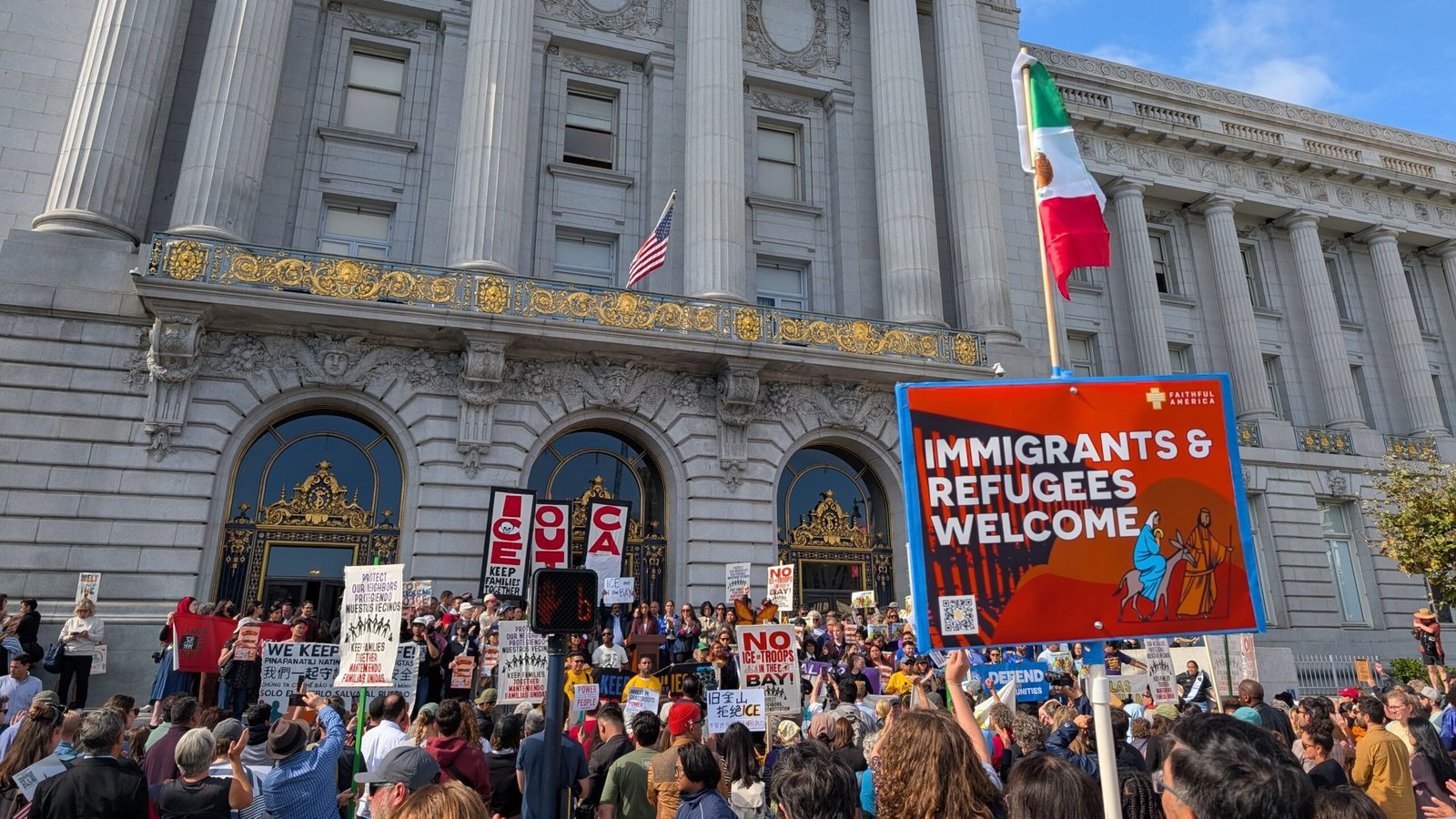
The tension culminated in a defiant rally at City Hall on Thursday, where approximately 150 demonstrators gathered despite the news of the troop withdrawal. Labor unions, cultural leaders, and city officials took the podium to denounce the influence of tech billionaires on municipal security policy. District 9 Supervisor Jackie Fielder delivered a pointed critique of the private-sector involvement in federal law enforcement decisions.
“This city does not belong to them,” Fielder told the crowd, specifically targeting the role of pro-Trump billionaires in the initial deployment discussions. “We are not backing down. We are not flying under anyone’s radar.” The sentiment among attendees reflected a broader concern that the city’s autonomy is being leveraged by wealthy individuals with direct lines to the White House.
Ongoing Vigilance Across the Bay Area
While San Francisco may have avoided a direct confrontation this weekend, the regional outlook remains tense. Federal personnel maintain a presence at Coast Guard Island, and cities like Oakland and San Jose continue to monitor federal movements closely. Protests are expected to persist as community leaders attempt to shift the national discourse.
Claire Donovan, communications manager for Bay Resistance, views the current situation as a strategic victory for “people power” but warns against complacency. According to Donovan, the goal is to reframe the narrative surrounding urban challenges, shifting the focus from crime-centric rhetoric to the protection of communities under political attack. The mobilization infrastructure built over the last week remains intact, ensuring that the Bay Area is prepared for any future shifts in federal policy.