
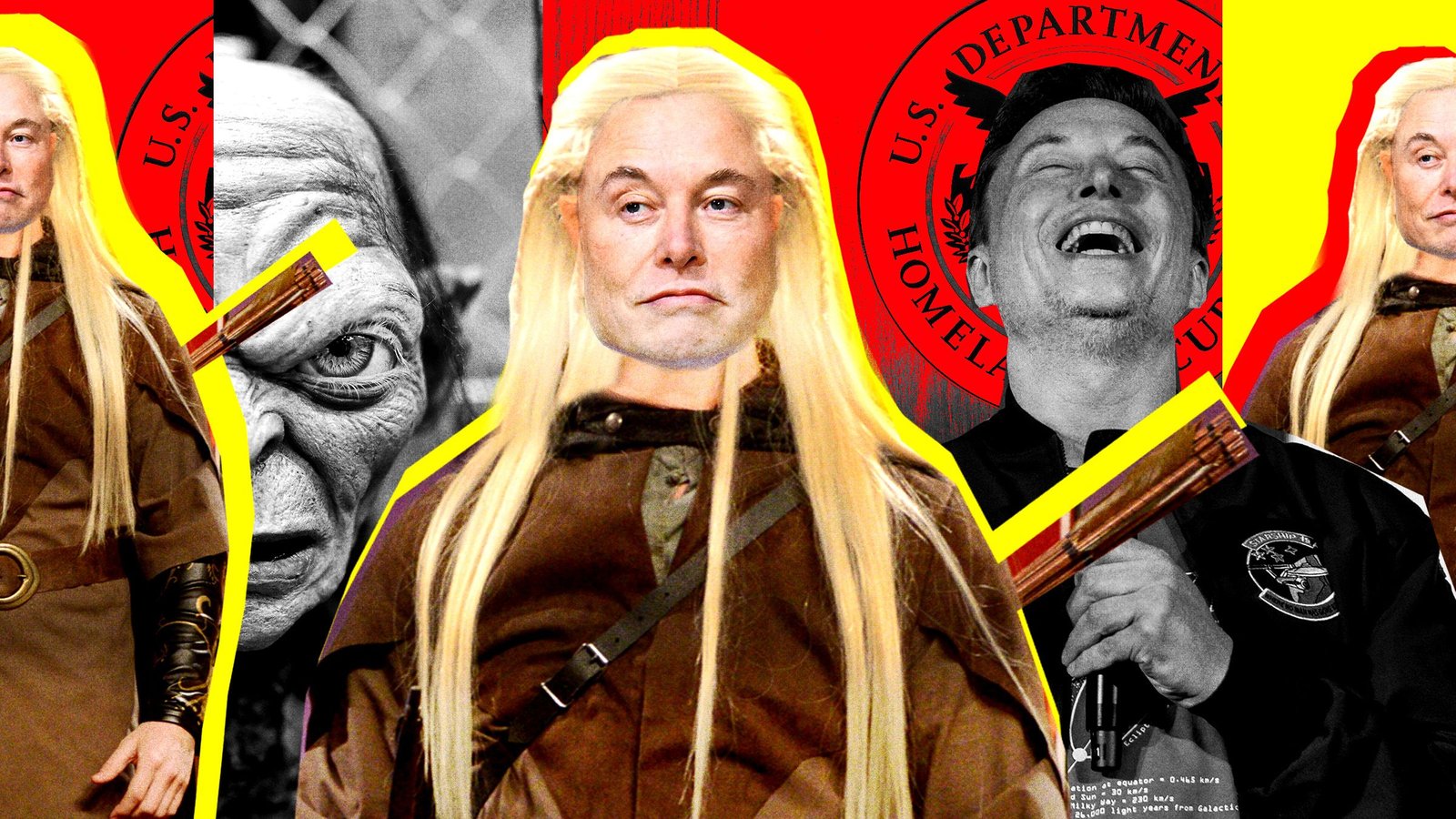
The U.S. Department of Homeland Security and tech mogul Elon Musk are facing intense backlash from literary scholars for appropriating The Lord of the Rings imagery to justify border enforcement and far-right ideologies. By leveraging J.R.R. Tolkien’s mythopoeic world, these entities have sparked a heated debate over the misinterpretation of the author’s anti-authoritarian themes and the psychological motivations behind “Shire-posting.”
The “Shire-posting” Controversy at Homeland Security
Immigration and Customs Enforcement (ICE), a division of the Department of Homeland Security, recently integrated quotes and iconography from Tolkien’s legendarium into its recruitment and public relations efforts. A notable post on X (formerly Twitter) featured the character Merry Brandybuck warning, “There won’t be a Shire, Pippin.” This reference to the encroaching shadow of Sauron was repurposed to frame modern immigration as an existential threat to the American “homeland.”
Critics argue that this government appropriation of pop culture—ranging from Pokémon to Halo—aims to project a “based” or relatable image to a specific digital demographic. However, the use of Tolkien’s work is viewed as particularly egregious due to the inherent contradiction between the author’s worldview and the aggressive tactics of state enforcement agencies.
Elon Musk’s Failed Lore Defense of Far-Right Figures
Elon Musk further fueled the controversy this week by using Tolkien’s narrative to defend Tommy Robinson, a prominent British far-right agitator. Musk asserted that the peaceful life of Hobbits was only possible because they were “protected by the hard men of Gondor.”
The Myth of the “Hard Men of Gondor”
Tolkien scholars and readers quickly dismantled Musk’s interpretation. In the actual text of The Lord of the Rings, the kingdom of Gondor is depicted as a realm in decay, governed by corrupt and ineffective stewards. Far from being “hard men” providing a security umbrella, the soldiers of Gondor were often failing in their duties until the return of the rightful king. Furthermore, the Shire’s survival is traditionally attributed to the Hobbits’ own humility, resilience, and moral fiber, rather than a reliance on external militarism.
Musk’s history with “nerd culture” has often been fraught with criticism. From his widely mocked Elden Ring character builds to allegations of cheating in Diablo IV, his attempts to align himself with the gaming and fantasy communities are frequently perceived as performative efforts to gain credibility among Silicon Valley technocrats.
Silicon Valley’s Obsession with Tolkien’s Power Symbols
The appropriation of Middle-earth is deeply rooted in the tech elite’s culture. Peter Thiel, the billionaire co-founder of Palantir Technologies, named his data analytics firm after the “seeing stones” used by the dark lord Sauron and the corrupted wizard Saruman. Similarly, Vice President JD Vance, a protégé of Thiel, named his venture capital firm Narya, after the Ring of Fire worn by Gandalf.
Robin Anne Reid, editor of Studies in Tolkien, expressed horror at how alt-right figures and technocrats have weaponized these works. While the 1960s counterculture embraced Tolkien through a lens of environmentalism and peace—manifesting in “Frodo Lives!” buttons—the modern far-right in Italy and the U.S. has reframed the narrative as a struggle for racial and traditionalist purity.
The Real Tolkien: Anti-Authoritarianism and Moral Depth
Janet Croft, editor of the journal Mythlore, argues that these modern interpretations suffer from a shallow reading of the text. While J.R.R. Tolkien was a conservative, a devout Catholic, and a monarchist, he remained a fierce critic of “lunatic” racial laws and expressed a deep-seated hatred for apartheid. His letters reveal a man who viewed the act of “bossing other men” as the most improper job for any human being.
Scholars point to “The Scouring of the Shire,” the penultimate chapter of the trilogy, as the ultimate refutation of modern authoritarian appropriation. In this sequence, the Hobbits return home to find their land occupied by ruffians and “rent-a-cops” who have imposed a police state. The heroes do not call for “hard men” to save them; they lead a grassroots uprising to expel the oppressors, reinforcing Tolkien’s fundamental distrust of centralized, coercive power.