
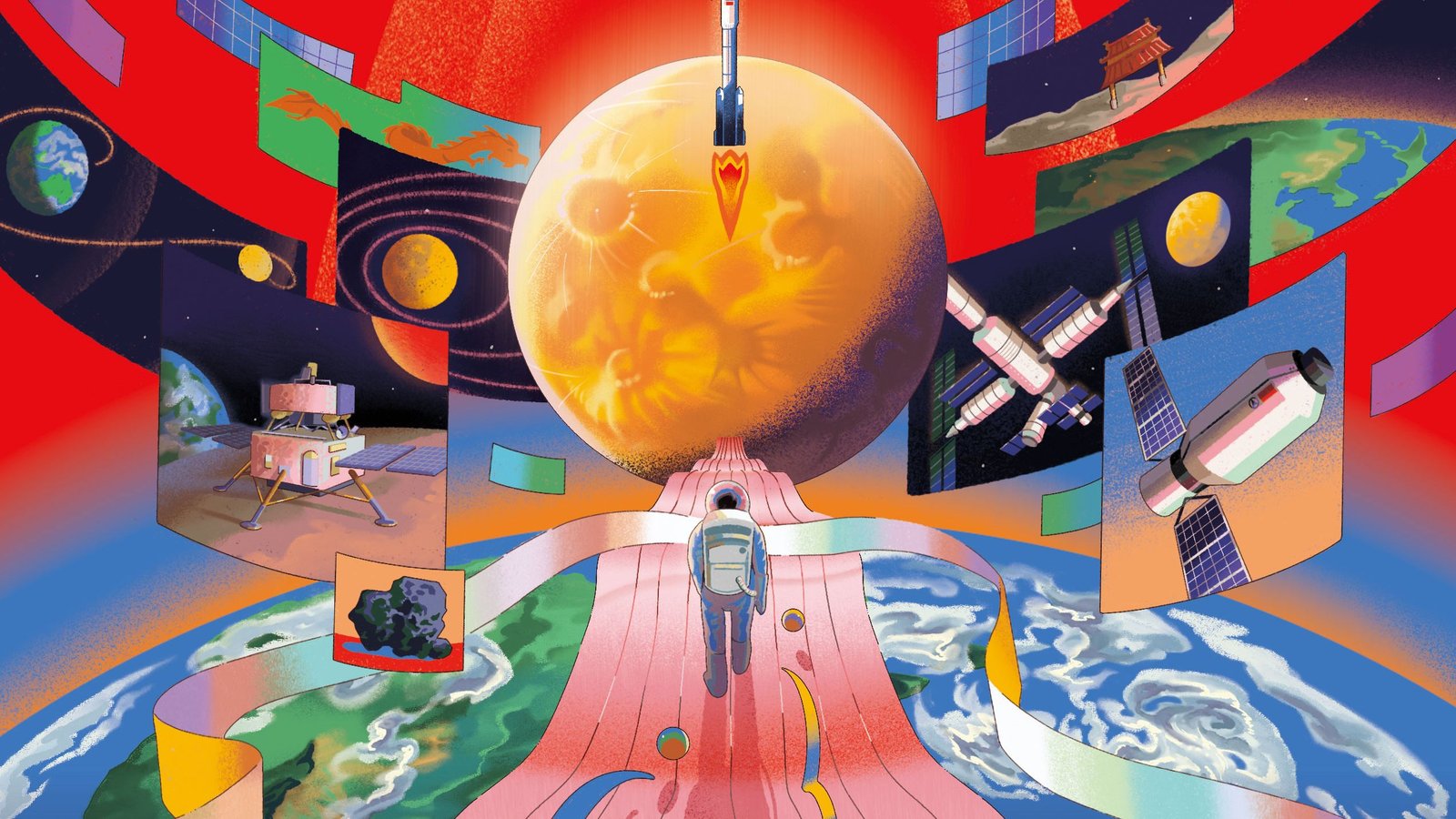
The United States is currently surrendering its lead in the second space race as systemic budget cuts and administrative turmoil paralyze NASA’s Artemis program while China’s lunar timeline remains on track for a 2030 landing. Despite political rhetoric promising a return to American dominance, a combination of institutional brain drain and technical over-complexity has left the U.S. lunar mission in a state of strategic paralysis.
The Isaacman Hearing: A Visual Omen of Decline
During Jared Isaacman’s confirmation hearing last April, Senator Ted Cruz presented a provocative poster depicting a future where a massive Chinese flag dominated the lunar landscape, dwarfing a minuscule American presence. While Isaacman, a billionaire space veteran, offered a confident rebuttal, the underlying reality is far more grim. Since that testimony, the U.S. space agency has faced a 24 percent budget slash and the exodus of nearly 4,000 experienced employees, leaving NASA’s leadership in a state of constant flux.
The appointment of Sean Duffy, a former reality TV star, as acting NASA chief further complicated matters. Duffy’s public disputes with Elon Musk—whose SpaceX technology is foundational to the current lunar plan—and the subsequent reinstatement of Isaacman into the administration’s orbit highlight a lack of cohesive mission control. Meanwhile, the White House issued an executive order demanding a lunar landing by 2028, a goal that most experts believe is currently unattainable under existing conditions.
Strategic Self-Sabotage and the Brain Drain
For decades, the term “moonshot” represented the pinnacle of American ingenuity. Today, that legacy is under threat. While China dominates the global markets for electric vehicles, solar energy, and high-quality scientific research, the U.S. has responded by gutting its own science funding. Nine former high-ranking NASA officials, serving under both Trump and Biden, expressed deep skepticism regarding America’s chances. One official characterized the current strategy as “a race without a plan to win,” noting that the U.S. has essentially positioned itself for failure by prioritizing political theater over logistical reality.
The South Pole Stakes: Water, Ice, and Helium-3
The race to the moon is not merely about national pride; it is a scramble for critical resources. Both nations are targeting the lunar south pole, a region characterized by treacherous terrain and craters trapped in eternal darkness. Scientists believe these areas contain vast deposits of water ice and Helium-3, an isotope that could revolutionize quantum computing and nuclear fusion. Claiming these prime landing sites, such as the ridge of the Shackleton Crater, could shift the global balance of power for centuries.
China’s National Space Administration (CNSA) has demonstrated remarkable consistency. The upcoming Chang’e-7 mission, scheduled for launch this August, aims to be the first to extract lunar water. Unlike the fragmented U.S. approach, Beijing’s program is noted for its reliability; when the CNSA sets a deadline, they typically meet it. Their crewed mission, involving a streamlined two-rocket architecture, is firmly targeted for launch before 2030.
Engineering Gridlock: The Starship Paradox
The American Artemis program is a “portfolio” of mismatched technologies, combining legacy hardware with unproven futuristic concepts. The Space Launch System (SLS) and the Orion capsule, built using repurposed Space Shuttle components, have cost taxpayers tens of billions of dollars despite flying only once. To reach the lunar surface, NASA is now heavily reliant on SpaceX’s Starship, a vehicle that presents unprecedented logistical challenges.
The Refueling Nightmare
Unlike China’s two-rocket plan, a single U.S. lunar mission could require more than 40 Starship launches to facilitate in-space refueling. This process involves transferring cryogenic liquid oxygen and methane in orbit—a feat that has never been attempted. NASA engineers recently calculated that the complexity of this “simplified” architecture could set the program back by years, especially as SpaceX grapples with development delays and public test failures.
Geopolitical Fallout: The End of American Hegemony
As NASA struggles with internal buyouts and the loss of top-tier talent, the geopolitical stakes continue to rise. Critics argue that the U.S. is currently acting as a “has-been” power, clinging to legacy systems while China leapfrogs ahead. The Senate’s insistence on funding specific rockets that current leadership may not even want—combined with massive cuts to the agency’s operational core—reflects a “political psychosis” in Washington.
If Chinese astronauts livestream a 4K landing while the U.S. remains grounded by bureaucracy, it will signal more than a scientific victory; it will be a declaration that the American Century has concluded. Some industry insiders suggest that a “Sputnik moment”—a public and humiliating defeat—may be the only thing capable of forcing the United States to prioritize actual engineering over political infighting and social media provocation.