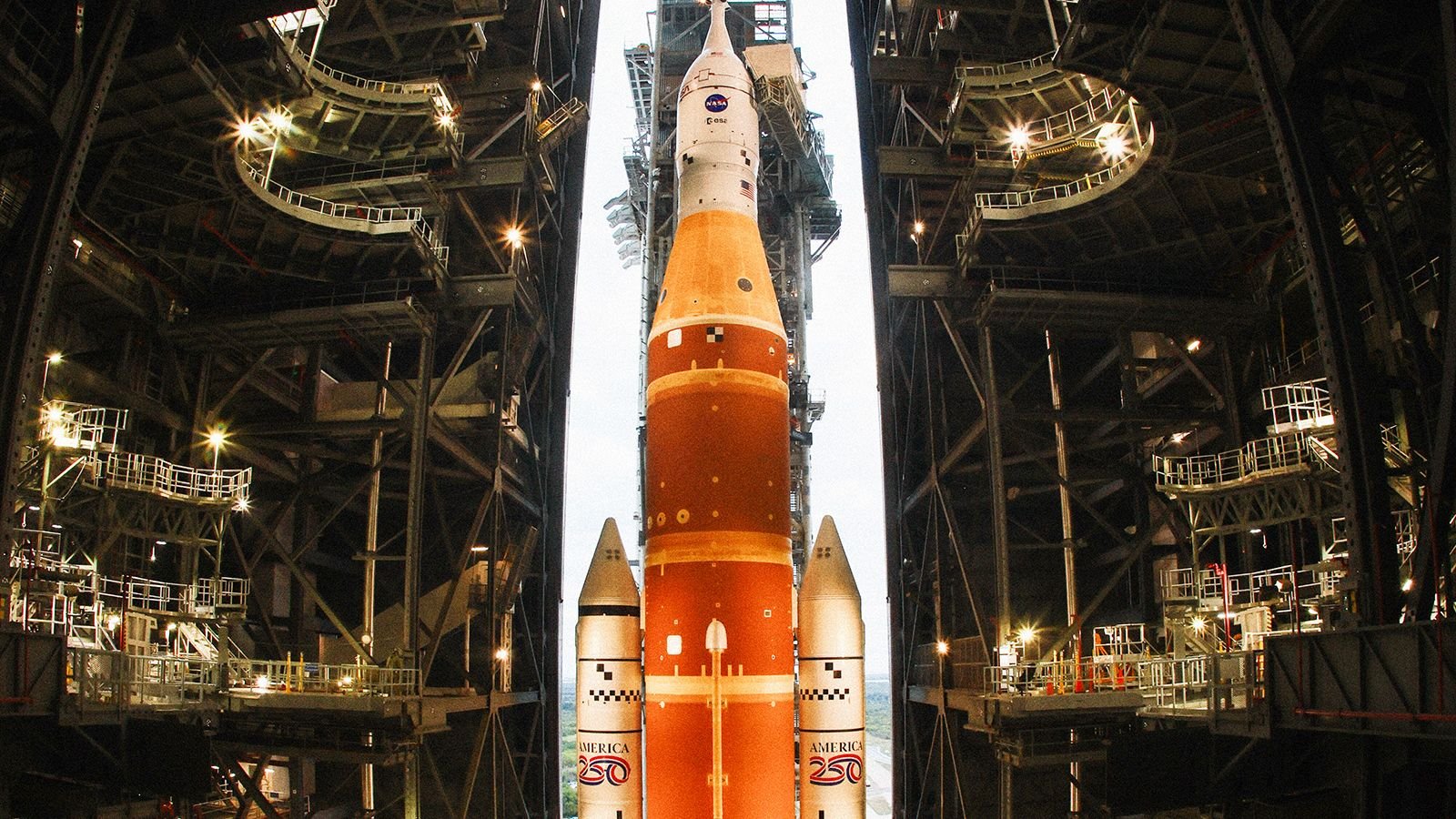
NASA is aggressively restructuring its Artemis program, canceling major rocket upgrades and delaying the first crewed lunar landing to the Artemis IV mission in a strategic bid to outpace China’s space ambitions and rectify chronic launch delays. This overhaul, driven by a need for operational efficiency, prioritizes a standardized rocket configuration to transform the Space Launch System (SLS) from a bespoke engineering project into a high-frequency launch vehicle.
A Geopolitical Race: Why NASA is Cutting Red Tape
The decision stems from growing concerns that China’s rapid progress in space exploration could result in a “Sputnik moment,” where America’s greatest geopolitical adversary lands humans on the moon before NASA returns. Jared Isaacman, a key figure in revitalizing the agency’s deep-space strategy, emphasized that the current “glacial pace” is no longer sustainable.
“NASA must standardize its approach, increase flight rate safely, and execute on the president’s national space policy,” Isaacman stated. He warned that with credible competition increasing daily, the agency must eliminate delays to achieve its objectives. The shift aims to address a critical bottleneck: the SLS flight rate. While the Apollo era saw launches every few months, nearly 3.5 years have passed since the Artemis I mission, a timeline Isaacman described as “just not the right pathway forward.”
The New Flight Path: Artemis III and IV Reconfigured
The revised Artemis roadmap introduces several fundamental shifts to the mission architecture:
- SLS Simplification: NASA has canceled the Exploration Upper Stage (EUS) and the Block IB upgrade.
- Artemis III Pivot: Originally intended as the return to the lunar surface, Artemis III will now serve as a docking demonstration. The Orion spacecraft will launch on a standard SLS and dock with commercial landers—SpaceX’s Starship or Blue Origin’s Blue Moon—in low Earth orbit (LEO).
- Artemis IV as the New Milestone: This mission will now facilitate the first human lunar landing of the 21st century.
- Annual Flight Cadence: NASA targets a mid-2027 launch for Artemis III, followed by annual missions and at least one lunar landing in 2028.
Standardizing the SLS for High-Frequency Launches
Technical hurdles, including persistent hydrogen and helium leaks during prelaunch preparations for Artemis I and II, have historically caused monthslong delays. A senior NASA official noted that treating every rocket as a “work of art” with major configuration changes has hindered progress. By standardizing the SLS into a single, reliable configuration, NASA aims to launch as frequently as every 10 months.
To replace the canceled EUS, NASA will seek a commercially available “standardized” upper stage. Industry experts point to the Centaur V, currently utilized by United Launch Alliance’s Vulcan rockets, as the most logical successor. This transition allows NASA to utilize the SLS until commercial alternatives are ready to ferry crews to the moon, fulfilling congressional mandates while reducing costs.
Contractor Alignment and the “Apollo Philosophy”
Despite losing the multi-billion dollar EUS contract, Boeing has signaled its support for the accelerated schedule. Steve Parker, President and CEO of Boeing Defense, Space & Security, affirmed that the company is prepared to meet increased production needs for the SLS core stage, which remains the only vehicle capable of sending astronauts directly toward the moon in a single launch.
The new strategy mirrors the incremental risk-reduction philosophy of the 1960s. By breaking the lunar landing into smaller, preparatory steps—much like the sequence from Apollo 7 to Apollo 10—NASA aims to “buy down” technical risks involving docking, spacesuit performance, and lunar lander handling before committing to a surface landing.
Uncertainty Surrounding the Lunar Gateway
While the rocket strategy is now clear, the future of the Lunar Gateway remains an open question. The cancellation of the SLS Block IB eliminates the primary vehicle intended to launch heavy Gateway modules. While some components are already manifested on SpaceX’s Falcon Heavy, the agency has stayed quiet on whether the proposed lunar orbiting station will be downsized or replaced by a direct-to-surface Moon Base program.
Key political figures, including Senator Ted Cruz, continue to advocate for a permanent American presence near or on the moon. However, the immediate focus has shifted entirely to the ability to land. As NASA officials suggest, the implications of standardizing the SLS are focused on one primary goal: returning to the lunar surface before any other nation.