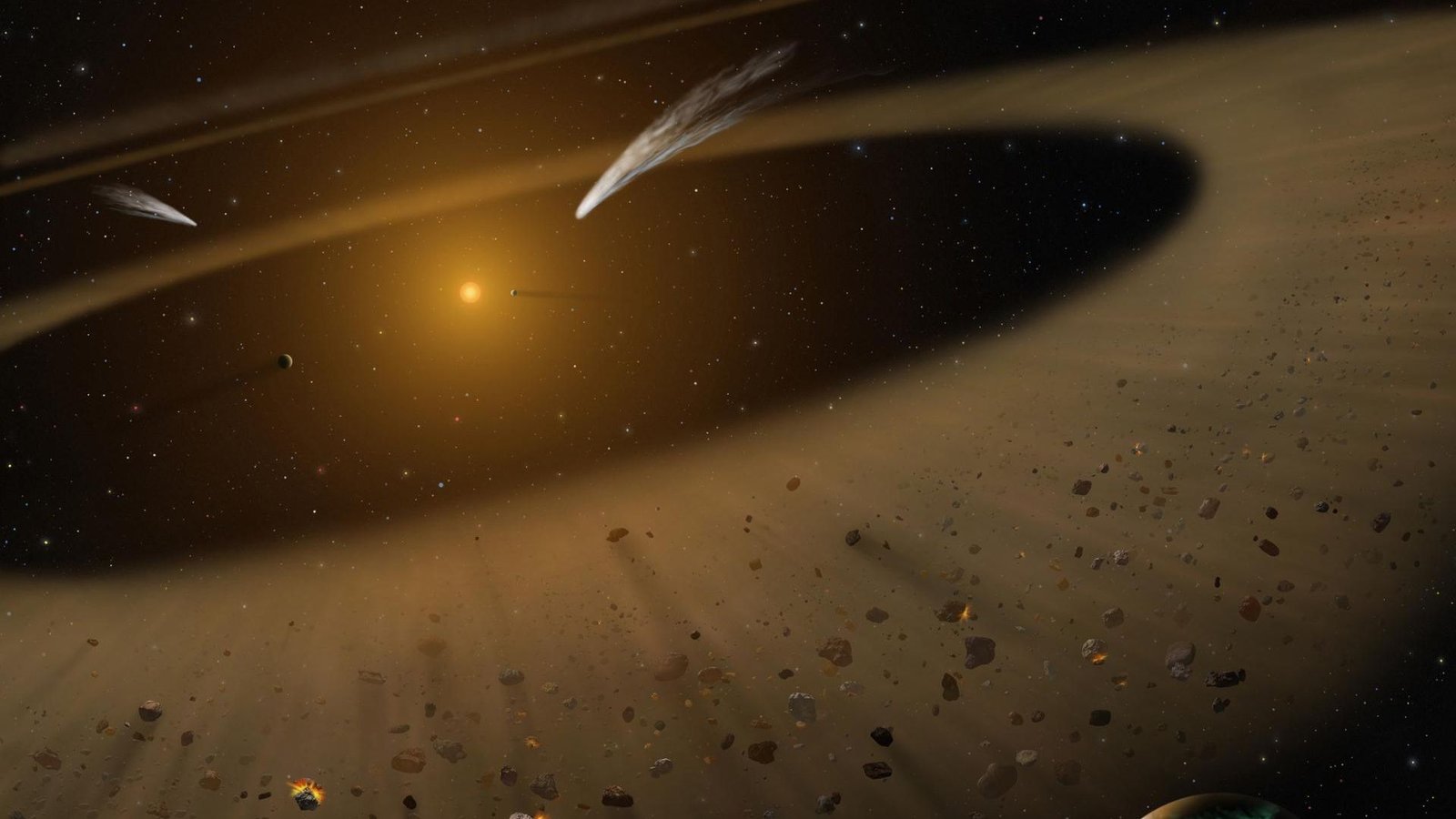
The Vera C. Rubin Observatory and the James Webb Space Telescope (JWST) are initiating a transformative era of deep-space exploration, aiming to catalog tens of thousands of undiscovered objects within the Kuiper Belt to decode the solar system’s violent history. This vast graveyard of icy debris, which begins approximately 30 astronomical units (AU) from the sun, contains the pristine chemical signatures of our planetary neighborhood’s birth 4.6 billion years ago.
Mapping the Solar System’s Frozen Frontier
Since the initial discovery of the Kuiper Belt in the 1990s, astronomers have identified roughly 4,000 Kuiper Belt objects (KBOs), ranging from dwarf planets like Pluto to icy comets. However, experts anticipate a tenfold increase in this census as the Vera C. Rubin Observatory in Chile ramps up its Legacy Survey of Space and Time (LSST). This advanced project will illuminate the “murky” edges of our system, filling critical gaps in the current astronomical record.
“Beyond Neptune, we have a census of what’s out there in the solar system, but it’s a patchwork of surveys,” explains Renu Malhotra, Regents Professor of Planetary Sciences at the University of Arizona. She emphasizes that the Rubin Observatory will fundamentally advance our knowledge by providing a comprehensive catalog of the solar system’s contents, eliminating the blind spots that have hindered previous models.
The Neptune Connection: Sculpting the ‘Kernel’
The Kuiper Belt is not merely a random collection of rocks; it is a structured archive of planetary migration. One of the most enigmatic features is a cluster of objects known as the “kernel,” located approximately 44 AU from the sun. These “cold classical” objects follow orbits that suggest a tumultuous past interaction with the gas giants.
Evidence of a Bumpy Planetary Migration
The prevailing “jumping Neptune” hypothesis suggests that Neptune migrated outward more than 4 billion years ago, influenced by the gravitational tugs of Jupiter and Saturn. Wes Fraser, an astronomer at the National Research Council of Canada, compares this phenomenon to a snowplow on a highway. “Imagine a snowplow driving along a highway, and lifting up the plow. It leaves a clump of snow behind,” Fraser notes. In this scenario, Neptune’s gravitational “jump” caused it to lose its grip on a specific population of objects, leaving the kernel behind as a permanent cosmic footprint.
Recent research led by Amir Siraj of Princeton University has utilized new algorithms to analyze 1,650 KBOs, confirming the existence of this kernel while identifying a potential “inner kernel” at 43 AU. Siraj suggests that these dual structures provide vital clues regarding the specific mechanics of Neptune’s outward journey.
The Hunt for Planet Nine and Planet Y
The quest to find undiscovered worlds remains a primary driver for Kuiper Belt research. While the hypothetical “Planet Nine” is predicted to orbit several hundred AU away, Siraj’s 2025 study explores the possibility of “Planet Y”—a world roughly the size of Mars or Mercury located between 80 and 200 AU. The Rubin Observatory possesses the sensitivity required to detect these elusive bodies, though their physical composition remains a mystery.
“We know nothing about the atmospheres and surfaces of gas giant or ice giant type planets at 200, 300, or 400 AU,” Fraser says. He suggests that Planet Nine could be a “tar ball” so dark it has evaded detection for decades. Whether these telescopes find new worlds or prove their absence, the data will refine our understanding of how efficiently planets form in the outer reaches of a star system.
Solving the Mystery of the Kuiper Cliff
A significant anomaly in our solar system is the “Kuiper cliff,” a sharp drop-off in object density at 50 AU. Compared to other stellar systems with debris disks extending to 100 AU or more, our system appears unusually small. “The solar system looks kind of weird,” Fraser admits, noting that finding a debris disk at 100 AU would make our system appear more average compared to its galactic peers.
While Fraser and his colleagues have found hints of a population at 100 AU, these detections remain unconfirmed. As the global astronomical community prepares for this massive influx of data, the Kuiper Belt stands as the final frontier for understanding our origins. As Malhotra concludes, the most pressing question remains: “What are we missing?”