
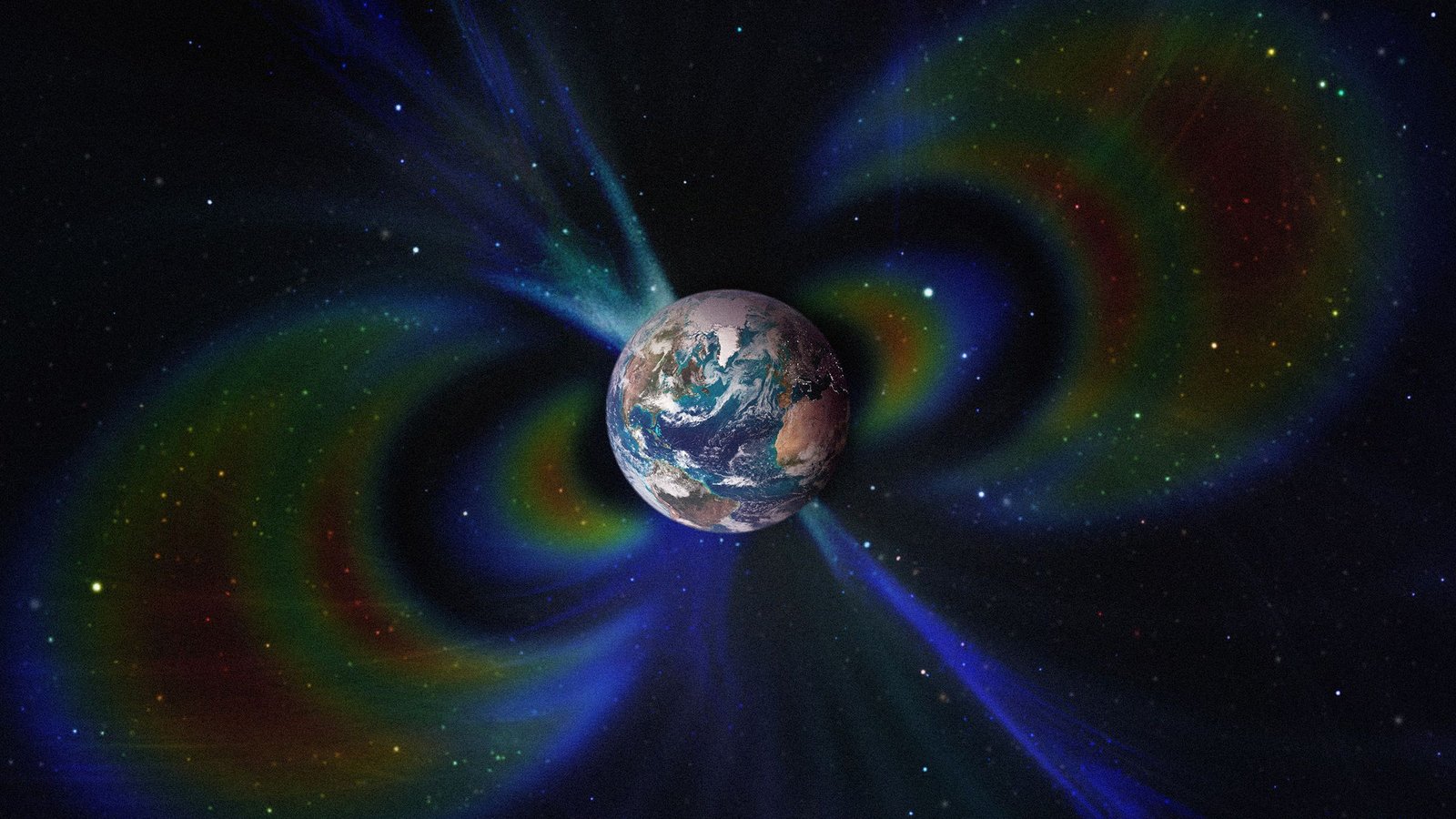
Researchers at the University of Liverpool have discovered that two continent-sized structures buried 2,900 kilometers deep within the mantle have dictated the behavior of Earth’s magnetic field for millions of years by disrupting the flow of liquid iron in the core. These anomalies, known as large low-shear-velocity provinces (LLSVPs), represent some of the most massive and enigmatic objects within the planet’s interior.
The Continent-Sized Anomalies Beneath the Crust
Each LLSVP is comparable in scale to the African continent, yet they remain hidden deep within the Earth’s mantle. Unlike the surrounding material, these regions are hotter, denser, and chemically distinct. Geologists first suspected the existence of these irregular areas in the late 1970s, though it took two decades of seismic research to confirm their presence. Recent data now identifies these structures as the primary drivers of magnetic field irregularities.
A “ring” of cooler mantle material surrounds these ultra-hot zones, creating a environment where seismic waves travel at varying speeds. This thermal contrast is not merely a geological curiosity; it serves as a massive heat exchanger that influences the mechanical behavior of the planet’s molten center.
How Mantle Heat Disrupts the Geodynamo
The study, published in Nature Geoscience, explains that the temperature differential between the LLSVPs and the rest of the mantle fundamentally alters how liquid iron circulates. Because the movement of iron in the outer core generates the Earth’s magnetic field—a process known as the geodynamo—any thermal interference creates significant physical consequences.
These hot and cold zones accelerate or decelerate the flow of liquid iron depending on the specific region. This creates a permanent asymmetry in the core’s movement, which explains why the Earth’s magnetic field does not possess a perfectly uniform shape, but rather the tilted and irregular configuration observed by scientists today.
Proving the Heterogeneous Mantle Theory
To confirm the link between these mantle masses and magnetic fluctuations, the research team employed supercomputer simulations. They compared a model of a uniform mantle against a heterogeneous model that included the LLSVPs. When the simulations were contrasted with real-world magnetic data, only the model incorporating the LLSVPs successfully reproduced the specific patterns and tilts recorded throughout history.
The simulations further revealed that while some sections of the magnetic field have remained stable for hundreds of millions of years, other regions have undergone dramatic shifts due to the influence of these mantle structures.
Implications for Paleobiology and Climate Science
“These findings have important implications for questions surrounding ancient continental configurations—such as the formation and breakup of Pangaea—and may help resolve long-standing uncertainties in ancient climate, paleobiology, and the formation of natural resources,” stated Andy Biggin, Professor of Geomagnetism at the University of Liverpool and lead author of the study.
The discovery challenges the traditional scientific assumption that Earth’s magnetic field behaves as a perfect bar magnet aligned with the planet’s axis when averaged over long periods. By proving that the mantle’s internal structure forces the magnetic field into a state of constant irregularity, the study provides a new framework for understanding the Earth’s evolution and its protective magnetosphere.