
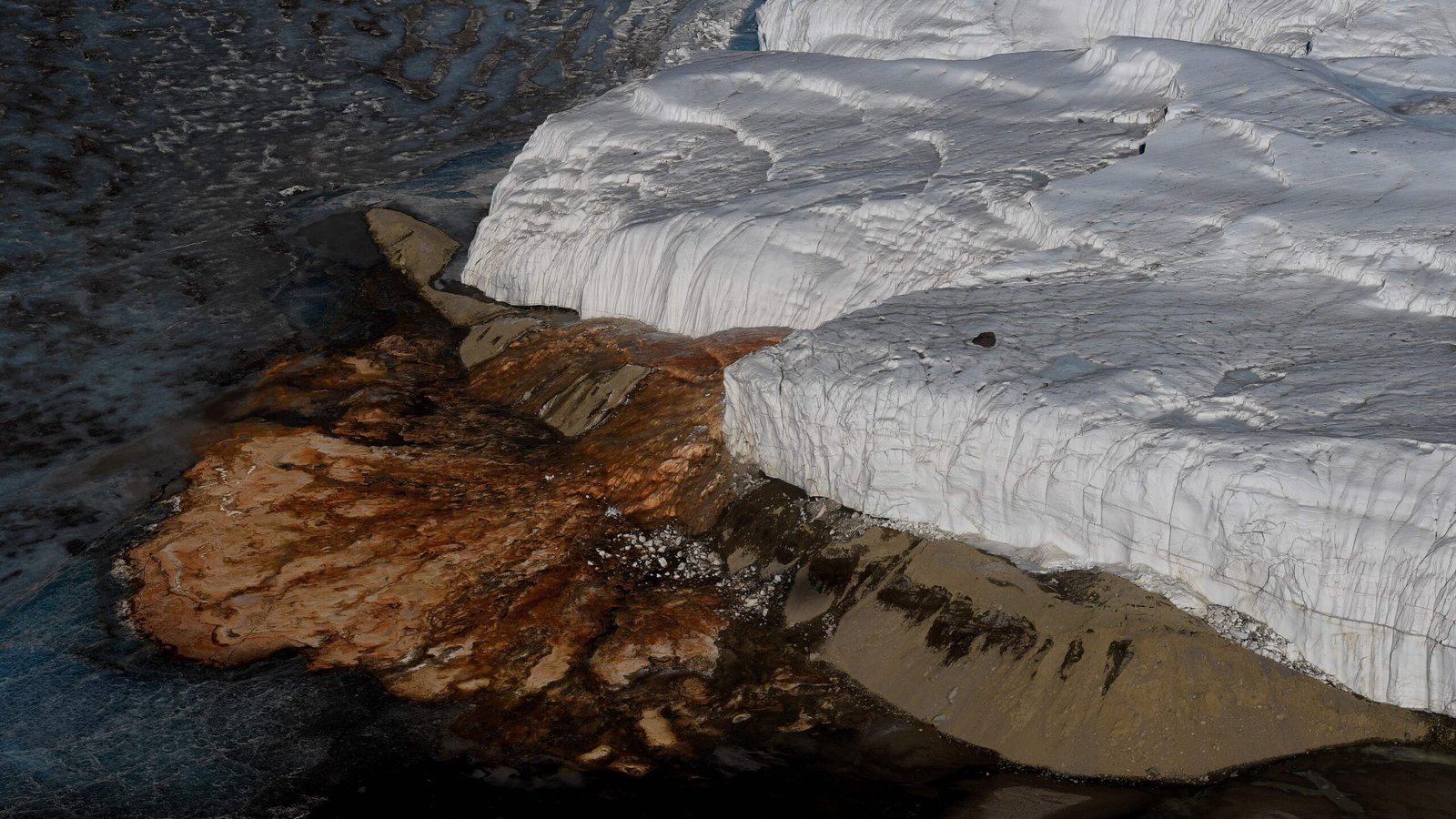
New research published in the journal Antarctic Science has finally decoded the mechanical forces behind the “Blood Falls,” a century-old geological enigma flowing from East Antarctica’s Taylor Glacier. By synthesizing GPS data, thermal sensors, and high-resolution imagery, scientists identified that extreme subglacial pressure—rather than simple melting—periodically forces ancient, hypersaline brine through ice fissures and into the open air.
The Chemistry of the Crimson Flow
When Australian explorer Griffith Taylor first discovered the falls in 1911, he hypothesized that red microalgae caused the startling coloration. Modern analysis refutes this, proving the tint originates from iron-rich nanospheres. These particles, containing traces of silica, calcium, aluminum, and sodium, are the byproduct of ancient bacteria thriving in an isolated subglacial ecosystem. Upon exiting the glacier and contacting oxygen, the iron oxidizes instantly, transforming the clear fluid into a vivid, rust-colored stream.
The fluid remains liquid despite temperatures plummeting to –20 degrees Celsius because of its unique origin. Approximately 2 million years ago, receding oceanic waters trapped a hypersaline reservoir beneath the glacier. This brine possesses a salt concentration so high that it effectively lowers the freezing point, maintaining a liquid state in the deep freeze of the Antarctic interior.
Glacial Pressure as a Hydraulic Trigger
While the color and chemistry were previously understood, the “engine” driving the eruptions remained elusive until recent data from a 2018 eruption event provided clarity. The Taylor Glacier acts as a massive, slow-moving piston. As the ice mass slides downstream, it compresses subglacial channels, building immense internal strain within the brine deposits. When this pressure reaches a critical threshold, the ice fractures, and the pressurized brine shoots through the resulting crevices in short, violent bursts.
A Hydraulic Brake for Taylor Glacier
This geological phenomenon serves a secondary, functional purpose for the glacier’s physics. The sudden release of brine acts as a hydraulic brake, momentarily slowing the glacier’s forward march by relieving the built-up stress. While this discovery closes the chapter on how the falls function mechanically, the long-term stability of this subglacial system remains under scrutiny as global temperatures fluctuate, potentially altering the delicate pressure balance of the Antarctic ice sheet.