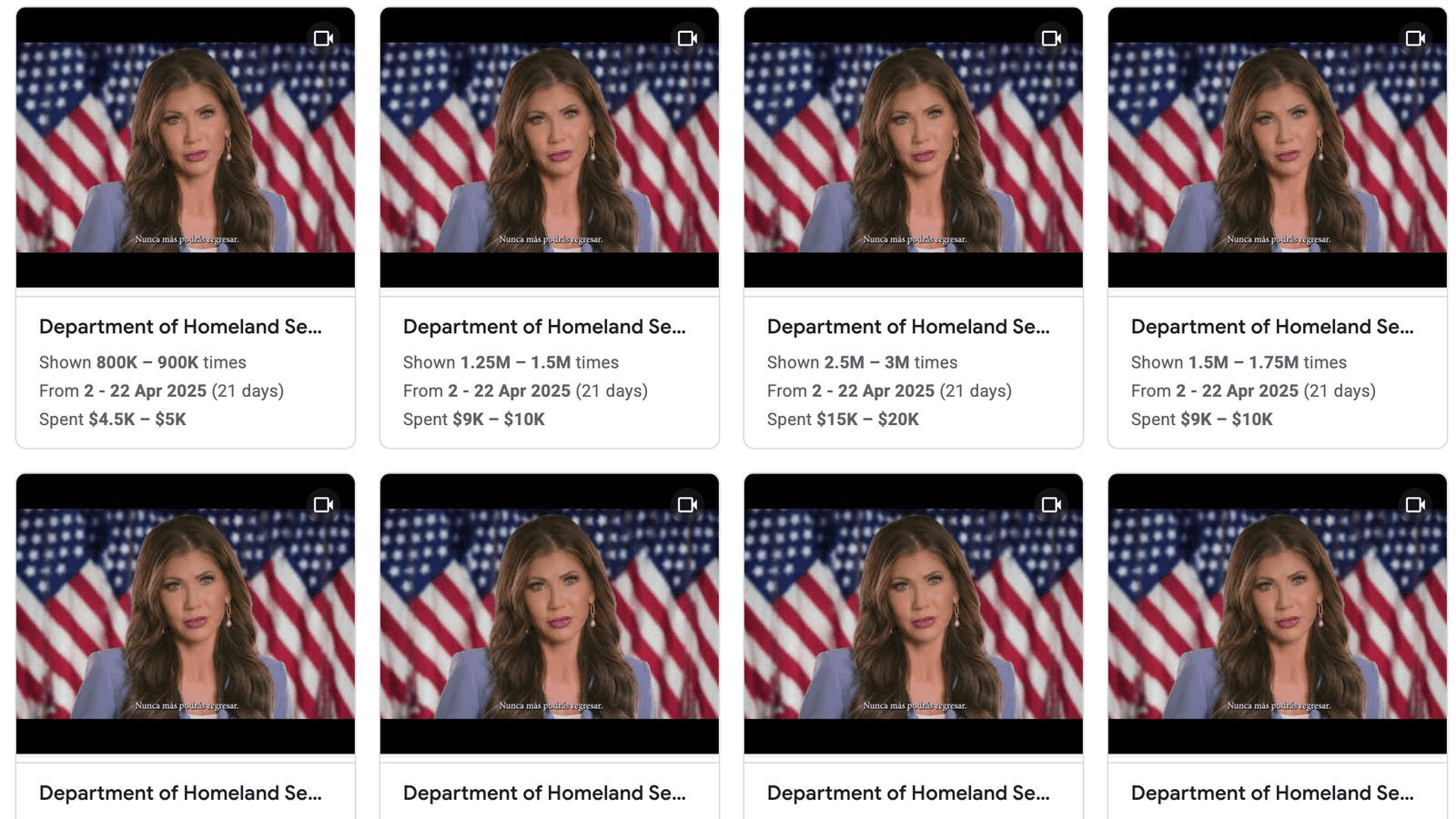
The U.S. Department of Homeland Security (DHS) has deployed a $594,600 digital advertising blitz across YouTube and broadcast networks to deter irregular migration by targeting established immigrant hubs in California, Texas, and Florida. Data retrieved from the Google Ads Transparency Center reveals a surgical strategy that prioritizes psychological impact in states with high migrant populations over traditional border-region messaging.
Strategic Spending Targets Immigrant Strongholds
Internal data indicates that California received the largest share of the investment, with $208,000—roughly 35 percent of the total budget—allocated to the state. Texas and Florida followed closely, each seeing investments near $120,000, while Illinois and New York emerged as secondary priorities with disbursements of approximately $48,000 each. In a notable shift from conventional border security tactics, Arizona received only $20,300, suggesting the DHS is focusing its resources on areas where misinformation regarding legal status often circulates within vulnerable communities.
This initiative, which officially launched on February 17, utilizes advanced targeting technology and confrontational rhetoric. The DHS designed the campaign to warn individuals of immediate deportation and permanent bans on re-entry. These advertisements appear across broadcast television, social media platforms, and direct text messages, featuring multiple language variations to reach specific demographic segments.
Aggressive Rhetoric and Cross-Border Expansion
The campaign’s tone shifted toward high-intensity warnings as it expanded into Mexican territory. Ads featuring South Dakota Governor Kristi Noem began airing during prime-time television and major soccer matches in Mexico. In these spots, Noem employs explicitly aggressive language, linking irregular migration to violent crime and stating, “If you come to our country and violate our laws, we will hunt you down.”
The messaging strategy explicitly connects migration with “pedophiles, rapists, and murderers,” a move intended to maximize the deterrent effect through fear. While the US government utilizes legal loopholes to broadcast these messages on Mexican networks like Televisa, the content has sparked a significant diplomatic rift.
Mexico Moves to Ban “Foreign Propaganda”
Mexican President Claudia Sheinbaum has responded to the campaign by proposing an urgent legal reform to the Federal Telecommunications Law. Sheinbaum characterized the ads as a violation of national sovereignty and “discriminatory propaganda” that risks the dignity of migrants. The proposed legislation aims to close a 2014 loophole that allowed foreign governments to purchase local advertising space for political or ideological purposes.
Sheinbaum’s initiative seeks to prohibit foreign-funded political ads on both traditional television and digital platforms like Meta and Google. The president expressed confidence that the reform would receive unanimous support in Congress, framing the move as a necessary defense of national integrity against external interference.
Technological Enforcement and the CBP One Controversy
The DHS strategy integrates digital messaging with the CBP One app, a tool originally designed to streamline entry processes that now facilitates appointments for voluntary deportation and asylum applications. Human rights organizations have raised alarms regarding this integration, arguing that the app lacks transparent safeguards and effectively serves as a digital conduit for expedited removals.
This aggressive advertising push aligns with broader federal objectives to execute large-scale deportations by 2025. By leveraging the “Enemy Alien Act” and terminating humanitarian parole programs for specific nationalities, the administration is signaling a hardline shift. While Mexico has historically cooperated in managing migration flows, the escalating rhetoric and the use of hyper-targeted digital “warfare” are straining the bilateral relationship amidst ongoing trade and tariff disputes.