President Donald Trump hosted a high-stakes dinner for Silicon Valley’s elite at the White House on Thursday, securing massive domestic investment commitments from the world’s most powerful technology executives. The event, held in the State Dining Room and partially broadcast on C-SPAN, signaled a definitive shift in the relationship between Big Tech and the administration, as CEOs vied for favor through multi-billion-dollar pledges and public praise for the President’s economic and AI-centric agenda.
Zuckerberg and Cook Lead $1.2 Trillion Investment Surge
The evening functioned as a public demonstration of corporate alignment with the administration’s “America First” framework. President Trump opened the proceedings by describing the attendees as leaders of a “revolution in business and in genius.” Following this introduction, the President systematically questioned each executive regarding their financial commitments to United States infrastructure.
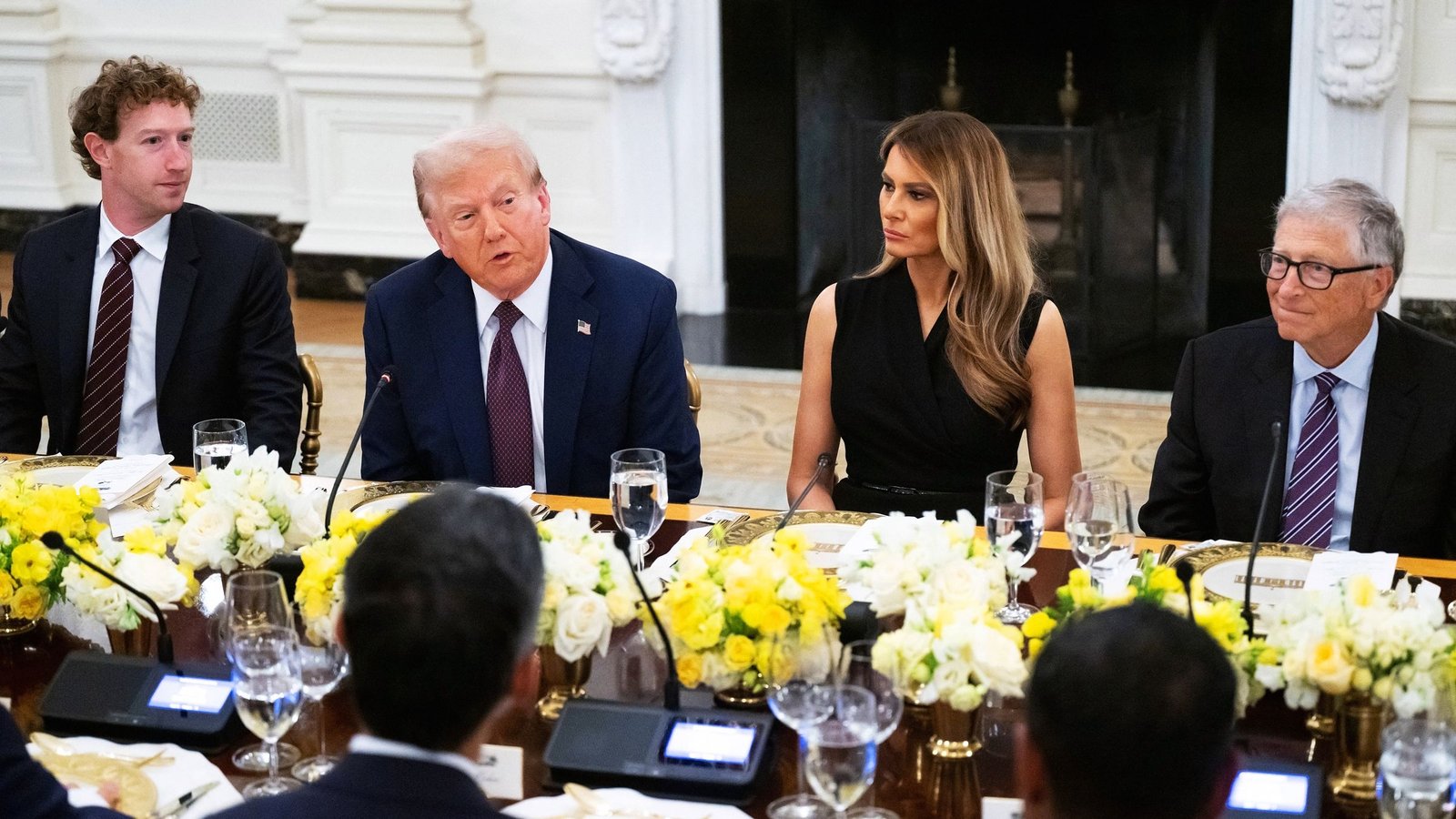
Mark Zuckerberg, CEO of Meta, occupied the seat of honor directly to the President’s right. Zuckerberg confirmed that Meta plans to inject approximately $600 billion into domestic infrastructure through 2028. This commitment was mirrored by Apple CEO Tim Cook, who reiterated Apple’s pledge to invest $600 billion in U.S. manufacturing. Industry analysts noted that Cook’s praise for the administration’s “tone” comes amid the looming threat of significant tariffs on smartphones, suggesting a strategic pivot to safeguard Apple’s supply chain.
Silicon Valley Aligns with Melania Trump’s AI Initiatives
Artificial Intelligence dominated the policy discussion, with several leaders praising the administration’s recent focus on the sector. Microsoft CEO Satya Nadella specifically highlighted First Lady Melania Trump’s leadership regarding the Presidential Artificial Intelligence Challenge and her efforts in “skilling and economic opportunity.” This follows the First Lady’s recent education-themed AI task force meeting.
Google CEO Sundar Pichai and AMD CEO Lisa Su joined the chorus of approval for the administration’s AI initiatives. Meanwhile, Oracle CEO Safra Catz, a former member of Trump’s transition team, offered the evening’s most enthusiastic endorsement. Catz asserted that the administration has “unleashed American innovation,” claiming that current efforts across the cabinet are ensuring a global competitive edge for the United States.
The Seating Chart of Power: Hierarchy at the State Dining Room
The arrangement of the guests served as a visual map of current political influence. While Zuckerberg sat at the President’s right hand, Microsoft co-founder Bill Gates was positioned next to the First Lady. Google co-founder Sergey Brin sat directly across from President Trump, accompanied by his partner Gerelyn Gilbert-Soto, whom Trump described as a “wonderful MAGA girlfriend.” Gilbert-Soto has recently gained attention for her vocal online support of the administration and her critiques of various cultural and governmental institutions.
The hierarchy was further evidenced by the “hinterlands” of the table, where executives like Nadella were placed further from the center of power. Notably, OpenAI CEO Sam Altman was granted a speaking slot, while other prominent figures, such as Meta’s Alexandr Wang, remained silent. White House AI and crypto czar David Sacks also maintained a prominent position in the evening’s dialogue.
The Strategic Silence: What Remained Unaddressed
Despite the celebratory tone, several critical industry challenges were conspicuously absent from the formal discussion. There was no mention of immigration policy—a vital concern for a sector heavily dependent on global talent—nor was there a deep dive into the environmental costs of powering the AI revolution. Furthermore, the potential inflationary impact of aggressive tariffs on consumer electronics was largely ignored, replaced instead by a focus on domestic capital expenditure.
Notably absent from the guest list were Elon Musk, Jeff Bezos, and Nvidia’s Jensen Huang. While their absence sparked speculation regarding scheduling or invitation status, their current standing with the administration remains strong through separate initiatives, such as the Department of Government Efficiency (DOGE) and major defense contracts.
A New Era of Corporate Pragmatism
The dinner marks a culmination of months of “cozying up” by Big Tech leaders who previously maintained a more adversarial or neutral stance toward the Trump administration. The shift suggests that for the captains of the technology industry, the primary guiding principle has become the consolidation of power and the navigation of a new regulatory landscape defined by direct presidential engagement and economic nationalism.