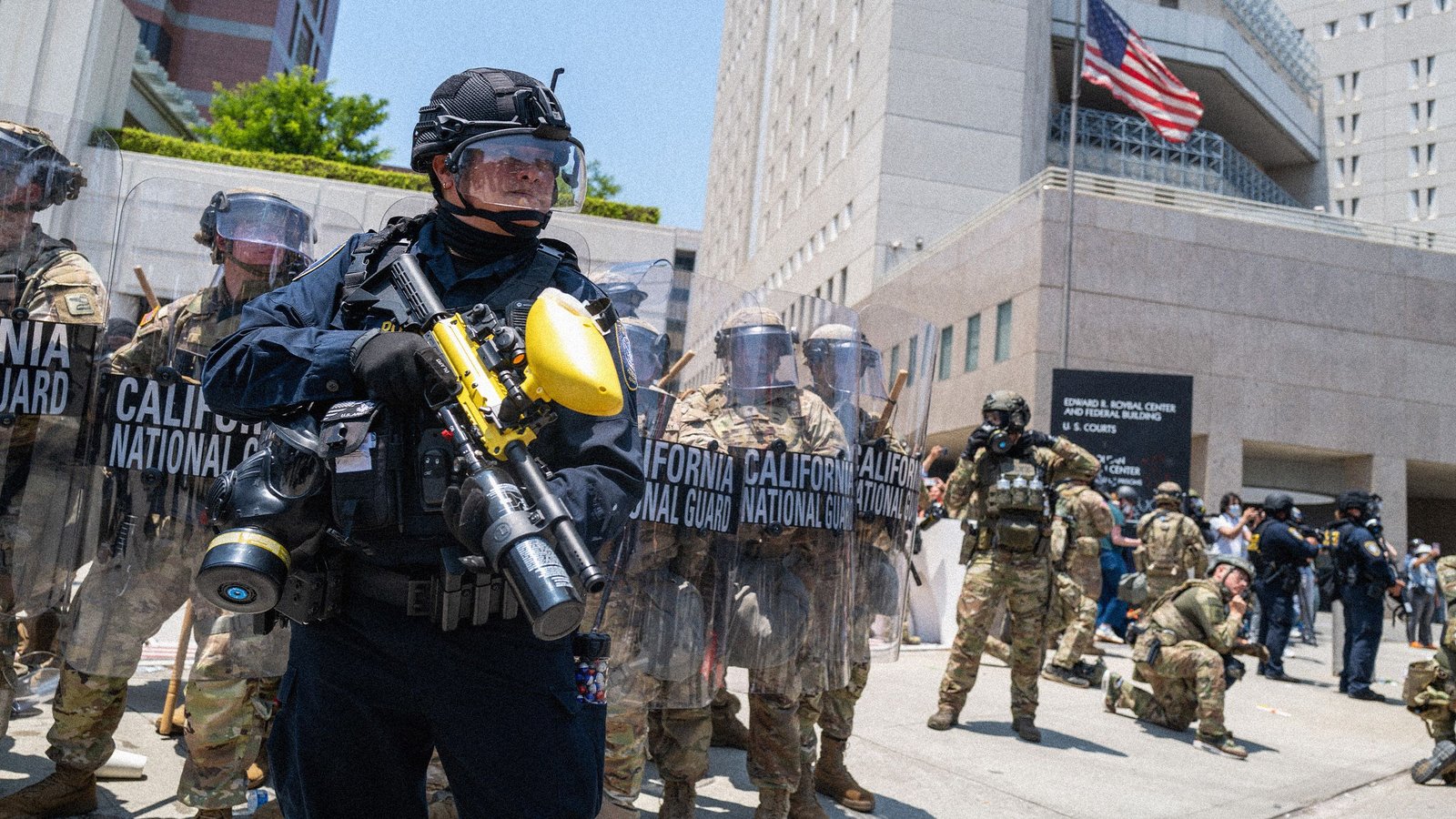
President Donald Trump escalated federal intervention in California on Monday by deploying over 700 active-duty Marines and federalizing 3,800 National Guard members to quell civil unrest in Los Angeles, sparking a fierce legal battle over the limits of executive power. This extraordinary use of military force, launched from Camp Pendleton, overrides the explicit objections of state leadership and marks a pivotal moment in the administration’s response to domestic protests.
Escalation in the Streets: From ICE Raids to Urban Unrest
The military surge follows a weekend of intensifying clashes in Los Angeles. Thousands of residents took to the streets on Friday after Immigration and Customs Enforcement (ICE) agents conducted sweeping raids on local businesses, targeting day laborers outside a Home Depot. While initial demonstrations remained peaceful, the situation deteriorated as police deployed riot shields and crowd control weapons. By the weekend, the conflict spread into immigrant-heavy neighborhoods, resulting in anti-ICE graffiti and the destruction of several Waymo autonomous vehicles.
The law enforcement response has drawn international scrutiny. Footage from the scene shows officers firing rubber bullets and CS gas at demonstrators and journalists alike. In one viral incident, an officer appeared to intentionally target Australian reporter Lauren Tomasi, shooting her with a rubber bullet at close range during a live broadcast. On Monday, the tension reached a fever pitch when CNN correspondent Jason Carroll was arrested during a live televised report.
California Strikes Back: The Battle for Sovereignty
Governor Gavin Newsom immediately denounced the troop deployment, characterizing the move as an “unmistakable step toward authoritarianism.” In a swift legal counterstrike, California Attorney General Rob Bonta filed a federal lawsuit alleging that the order violates state sovereignty and infringes upon the Governor’s constitutional role as the commander-in-chief of the California National Guard.
When questioned about the legal basis for the move, the Department of Defense directed inquiries to a U.S. Northern Command press release, which confirmed the mobilization of both Marines and National Guard personnel to the region.
The “Inherent Authority” Gamble: Bypassing the Insurrection Act
Under the “posse comitatus” doctrine, federal troops are generally prohibited from performing domestic law enforcement duties. While the Insurrection Act provides a workaround during rebellions, President Trump has notably declined to invoke it. Instead, the administration is leaning on a controversial 1971 Justice Department theory of “inherent authority,” which suggests the President can deploy troops to protect federal property and functions without a formal declaration of insurrection.
Furthermore, Trump utilized Title 10 of the U.S. Code to federalize the National Guard. While Title 10 is typically reserved for overseas missions in places like Iraq or Afghanistan, the administration is using it domestically to bypass Governor Newsom’s authority. Legal scholars note that without the Insurrection Act, these troops are technically barred from engaging in standard police activities, such as making arrests or dispersing peaceful crowds.
Preemptive Deployment and the Erosion of Accountability
Liza Goitein, senior director of the Brennan Center’s Liberty and National Security Program, warns that the administration is attempting to exercise Insurrection Act powers without accepting its legal constraints. She points out that Trump’s memorandum allows for “preemptive deployment,” authorizing troops even in areas where no protests have occurred. “He says they’re there to protect federal property,” Goitein observed, “but it looks a lot like quelling civil unrest.”
Expert Divide: Rebellion or Constitutional Overreach?
The legal community remains deeply divided on the legitimacy of the deployment. Anthony Kuhn, a 28-year Army veteran and managing partner at Tully Rinckey, argues the administration is justified. Pointing to images of burning vehicles and attacks on federal facilities, Kuhn classifies the unrest as a “violent rebellion.” He maintains that under Title 10, the President possesses straightforward authority to restore order when state leaders fail to do so.
Conversely, Rutgers University professor Bruce Afran argues that property damage and graffiti do not constitute a domestic insurrection. He warns that deploying combat-trained Marines against civilians fundamentally alters the democratic fabric. “The long-term danger is that we come to accept the role of the army in regulating civilian protest,” Afran stated, noting that this shift could permanently damage the relationship between citizens and the state.
Expanding the Military Mandate
The White House has remained defiant. Spokesperson Abigail Jackson blamed “Democrat leaders” for enabling chaos and stated that Trump will always step in to protect federal personnel. However, internal communications suggest a push for even more aggressive tactics. A letter from Homeland Security Secretary Kristi Noem to Defense Secretary Pete Hegseth reportedly requested that troops be authorized to detain and arrest “lawbreakers,” whom she described as “insurrectionist mobs.”
While some activists have called for service members to disobey what they deem unlawful orders, experts like David Coombs, a veteran of the JAG Corps, say such a move is unlikely in the field. While troops could theoretically refuse to conduct immigration raids under Title 10, the chain of command rarely allows for such litigation during active deployments. For the residents of Los Angeles, the presence of Marines—trained for high-intensity combat rather than community policing—signals a volatile new chapter in American civil-military relations.