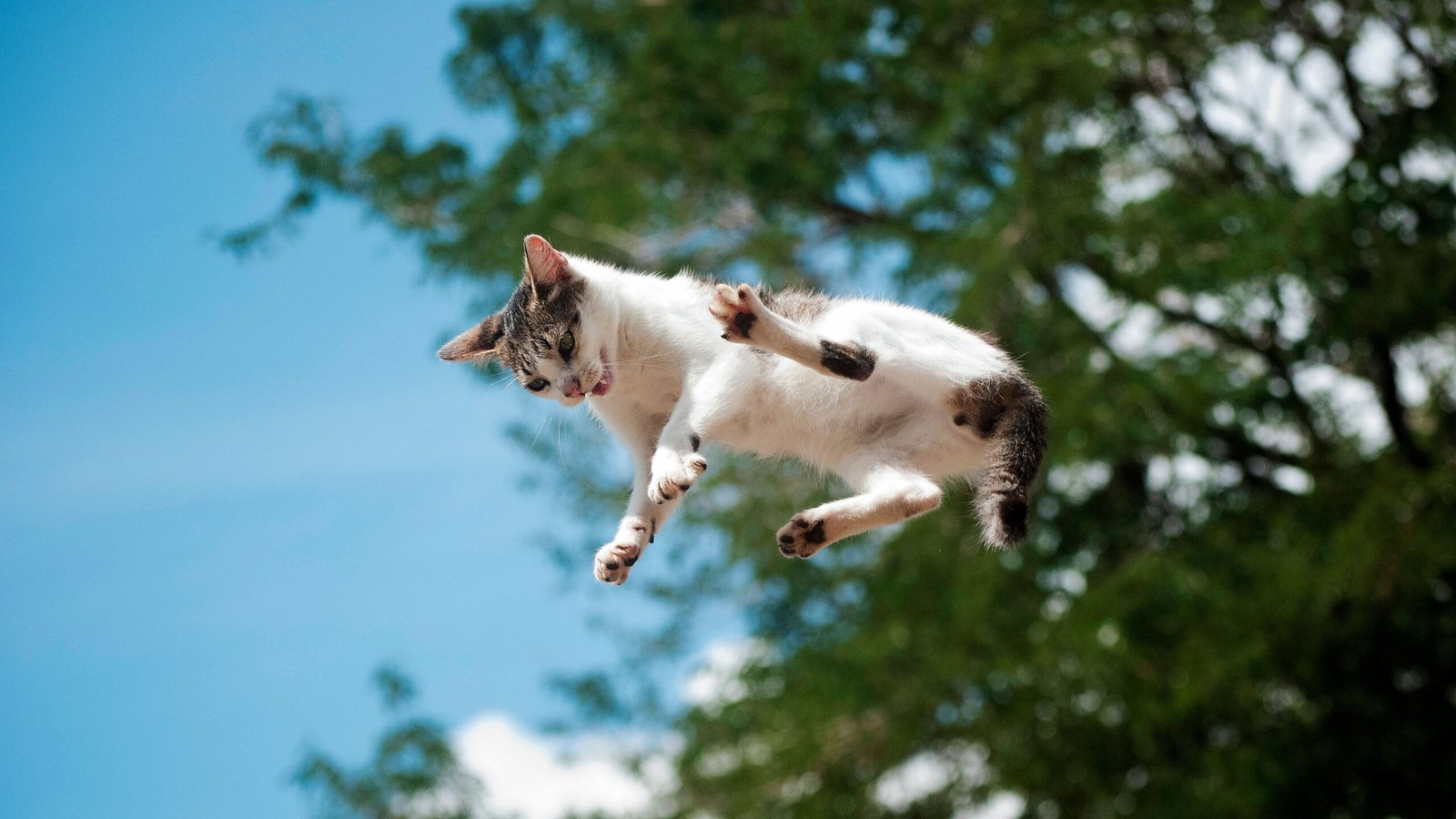
Researchers at Yamaguchi University in Japan have pinpointed the mechanical secret behind the feline ability to land upright, discovering that a specialized division of labor within the spine allows cats to bypass traditional physics during a fall. The study, recently published in the journal The Anatomical Record, reveals that these precision landings depend on a stark contrast between a highly flexible thoracic region and a rigid lumbar section that acts as a stabilizer.
Differential Flexibility Powers the Feline Righting Reflex
To understand how felines execute their signature midair maneuvers, the Japanese research team conducted a two-phase investigation. They first performed mechanical stress tests on the spinal columns of five deceased cats, isolating the thoracic and lumbar regions to measure their respective strength, flexibility, and resistance to axial rotation. The laboratory data revealed a significant anatomical disparity: the thoracic region—the upper part of the back—is exceptionally supple, capable of rotating approximately 50 degrees with minimal force. Conversely, the lumbar region, located in the lower back, is significantly stiffer and functions as a structural anchor during rapid movement.
Following the mechanical analysis, researchers utilized high-speed cinematography to capture live cats dropping onto soft cushions. These visual records confirmed that the “air-righting reflex” is not a uniform motion but a sophisticated, two-stage mechanical sequence driven by the spine’s unique architecture.
The Sequential Mechanics of Midair Orientation
The study clarifies that a cat’s ability to rotate without a solid surface to push against is not a defiance of physics, but a masterclass in internal torque management. Because the thoracic spine is so flexible, the cat first rotates its head and forelimbs toward the ground. During this phase, the rigid lumbar spine serves as a stabilizer, preventing the animal from losing control of its center of gravity. Once the front half of the body is oriented, the rest of the torso follows the established path.
The research team emphasized the importance of this timing, stating: “During air-righting, anterior trunk rotation was completed earlier than posterior trunk rotation. These results suggest that trunk rotation during air-righting in cats occurs sequentially, with the anterior trunk rotating first followed by the posterior trunk, and that their flexible thoracic spine and rigid lumbar spine in axial torsion are suited for this behavior.”
From Veterinary Care to Advanced Robotics
Beyond solving a long-standing biological mystery, the findings from Yamaguchi University carry significant implications for both medicine and engineering. By understanding the specific torque thresholds and rotational limits of the feline spine, veterinarians can develop more effective protocols for treating spinal injuries in domestic animals. Furthermore, the researchers suggest that this sequential rotation model could provide a blueprint for the next generation of agile robotics, allowing machines to maintain balance and reorient themselves in complex environments using bio-inspired spinal mechanics.