
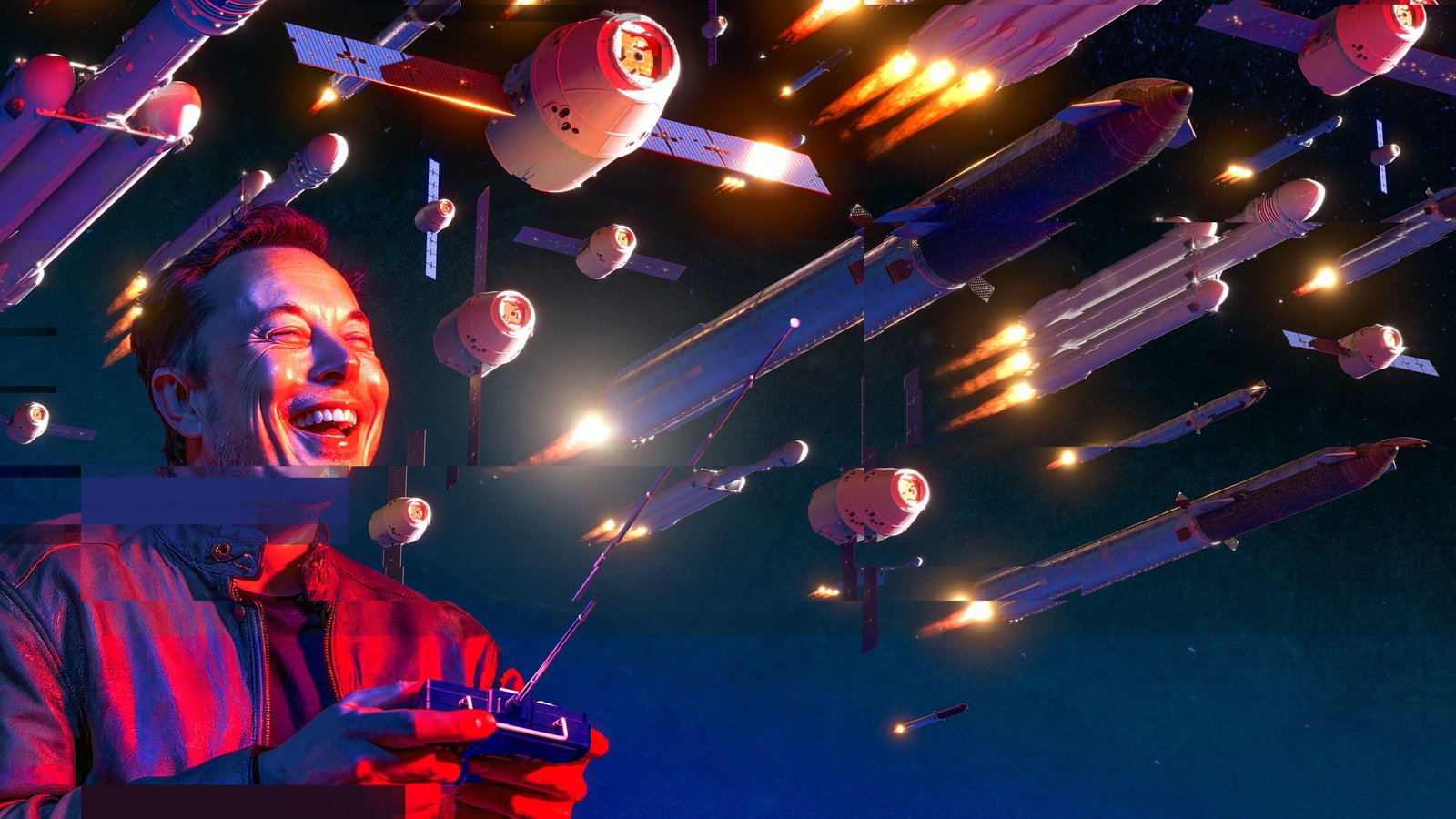
SpaceX is currently outperforming the rest of the world combined, launching rockets nearly every other day to cement Elon Musk’s absolute dominance over orbital infrastructure and modern military strategy. With 95 launches recorded in a single year—more than all other nations and private entities aggregated—Musk has transitioned from a tech disruptor to a geopolitical titan who holds the keys to global communication and extraterrestrial defense.
The Starlink Monopoly: Bandwidth as a Geopolitical Weapon
At the heart of this empire lies Starlink, a satellite internet venture that has rendered competitors nearly obsolete. Musk’s constellation currently boasts over 8,000 satellites; its nearest rival, Eutelsat’s OneWeb, operates a mere 630 with significantly lower bandwidth. Even Amazon’s highly publicized Project Kuiper, led by a former SpaceX executive, remains in the starting blocks with just 102 satellites in orbit, despite federal mandates requiring 1,600 by mid-next year.
This technical superiority translates into raw power on the battlefield. During the Russia-Ukraine conflict, a brief Starlink outage in July paralyzed drone operations and troop communications on both sides. The incident underscored a chilling reality: Musk’s private network is now the backbone of modern warfare. Furthermore, the SpaceX Dragon capsule remains the United States’ solitary vehicle for transporting humans to the International Space Station, a leverage point Musk has previously used in negotiations with government officials.
The New Frontier: Weaponizing the High Ground
The Pentagon is shifting its doctrine toward the active weaponization of space, responding to perceived threats from China and Russia. The Department of Defense is pouring billions into “orbital strike” capabilities—spacecraft designed to disable or destroy adversary satellites. While SpaceX may not manufacture the kinetic weapons themselves, their role as the primary “logistics provider” for these systems is virtually guaranteed.
Presidential initiatives have already signaled a willingness to commit $175 billion toward programs involving hundreds of orbiting interceptors. Victoria Samson, chief of space security at the Secure World Foundation, has raised alarms regarding the U.S. government’s extreme dependency on Musk. She notes that officials have effectively “yoked” national security to a “mercurial personality,” a move that could have unpredictable consequences for global stability.
Engineering the Monopoly: Reusability and the Merlin Engine
SpaceX’s stranglehold on the market is built on the back of the Merlin engine. Although former employees describe the engine’s performance as “terrible” in terms of pure efficiency, its robustness is unmatched. By “testing the ever-loving shit out of the engine” through thousands of hot-fires, SpaceX created a workhorse that allows for unprecedented reusability.
Today, a Falcon 9 can deliver payloads to low-Earth orbit at one-third the historical cost. This efficiency has allowed SpaceX to scale from 30 launches a year to over 130, effectively capturing the entire “space economy.” Companies like Planet Labs and even governmental agencies now rely almost exclusively on Musk’s “cheap access” to deploy their hardware.
Amazon and ULA: The Struggle for the “Niche”
While Jeff Bezos’ Blue Origin and the Boeing-Lockheed joint venture United Launch Alliance (ULA) attempt to compete, they are increasingly relegated to specialized roles. ULA’s new Vulcan rocket is designed for high-altitude geostationary orbits, yet it remains years behind schedule. Meanwhile, Blue Origin’s heavy-lift rocket has only flown once, leaving its representatives unable to articulate a clear competitive advantage over SpaceX’s proven flight record.
China, once a formidable challenger, is struggling to match Musk’s cadence. While Beijing aims to launch 28,000 satellites by the 2030s, their current failure rate remains high. This leaves Amazon as the only Western entity with the capital to challenge Musk, leveraging its AWS data center network to offer “private networking” that bypasses the public internet—a major selling point for security-conscious government clients.
The Starship Distraction: Mars vs. Total Earth Coverage
Musk frequently cites the colonization of Mars as his ultimate objective, but industry analysts like Lucas Pleney of Novaspace suggest this may be a strategic diversion. The Starship—the largest rocket ever built—is optimized for low-Earth orbit, not deep space. Its primary function appears to be the rapid deployment of next-generation Starlink satellites that are too large for the Falcon 9.
If Starship becomes operational at scale, Musk will achieve a “hammerlock” on global communications. He is already seeking permission to add 30,000 more satellites to his network, potentially allowing him to monitor or control a significant portion of the world’s data traffic. “He just points at Mars and says, ‘This is my objective. Don’t look at Starlink,’” Pleney warns, suggesting the real goal is total infrastructure dominance.
The “Golden Dome” and the Subscription to National Defense
The most controversial development is the proposed “Golden Dome,” a multi-billion-dollar missile defense shield involving space-based sensors and interceptors. Reports indicate that SpaceX has proposed a “subscription service” model for this system. Under this arrangement, the U.S. government would pay for access rather than owning the hardware—effectively giving Elon Musk a “kill switch” for America’s primary defense mechanism.
Despite volatile relationships with political leaders and threats to terminate his contracts, the U.S. government has found it functionally impossible to decouple from SpaceX. The Department of Defense and NASA are now so deeply integrated with Musk’s technology that any attempt to remove him would jeopardize national interests. As one industry insider succinctly put it: “His tech works way better than anybody else’s.”