Infinite Jest at 30: Redemption for the Modern ‘Litbro’?
Back Bay Books celebrates the 30th anniversary of David Foster Wallace’s Infinite Jest this February with a definitive new paperback edition, forcing a cultural re-evaluation of the 1,079-page monolith that defined 1990s American literature. As the industry revisits Wallace’s magnum opus, the conversation shifts from the book’s daunting complexity to the controversial “litbro” archetype it birthed—a demographic now facing both mockery and a strange kind of redemption in a post-literate world.
The 1,000-Page Monolith of 1990s Intellectualism
Published in 1996, Infinite Jest remains a staggering achievement of maximalist fiction. The narrative weaves through a near-future North American Superstate—the Organization of North American Nations—where corporate interests have purchased the naming rights to calendar years, such as the “Year of the Depend Adult Undergarment.” The plot centers on Hal Incandenza, a gifted but substance-dependent tennis prodigy, and a lethal, hyper-addictive video cartridge capable of killing anyone who views it.
Wallace’s “mega-text” functions as a literary centrifuge, spinning together influences ranging from Shakespeare and Dostoyevsky to Alcoholics Anonymous manuals and A Nightmare on Elm Street. With 96 pages of dense “Notes and Errata” and a vocabulary that demands readers define terms like “deuteragonist,” “brachiatishly,” or “kyphotic,” the novel has transformed from a book into a survivalist challenge. Completing it became a merit badge for a specific brand of reader: the “litbro.”
Dissecting the ‘Litbro’ Archetype
The “litbro” occupies a polarized space in the digital zeitgeist. Typically described as a pretentious, often male reader who treats challenging literature as a social weapon, this figure has become a staple of online satire. Michelle Zauner, the Japanese Breakfast frontwoman and author, characterizes this sect as pedantic young men for whom Infinite Jest serves as a rite of passage, comparable to how Little Women functions for aspiring female writers.
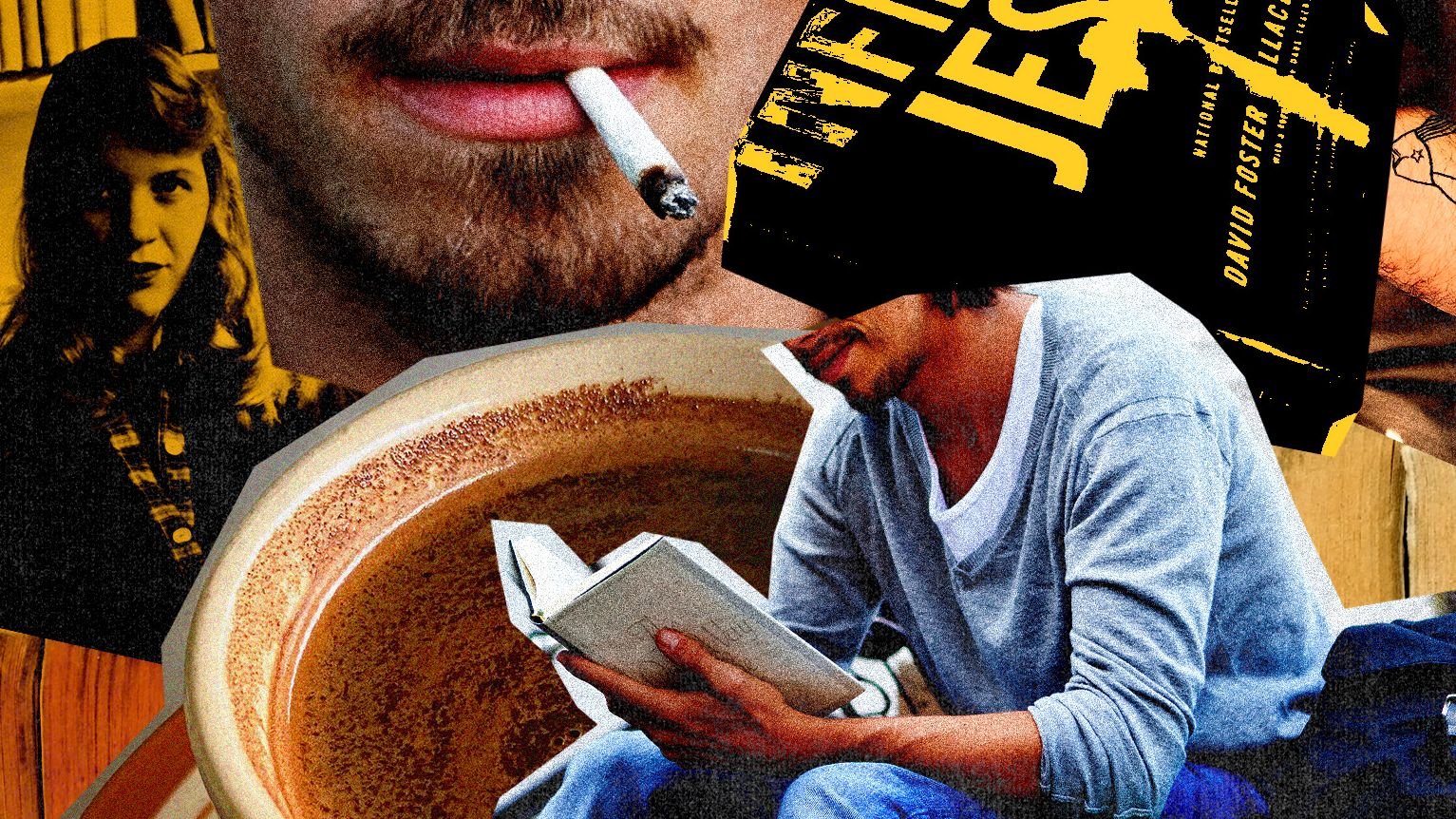
This persona gained further notoriety through cultural touchstones like the X account @GuyInYourMFA. Created by Dana Schwartz, the account parodied the “white man’s guide” to the Western canon, lampooning the type of reader who quotes Proust while smoking American Spirits. For these readers, Wallace—with his signature white bandana and “brainy but brawny” persona—was more than an author; he was a rockstar who made grammar and grueling intellectualism seem masculine.
The Darker Gradients of Erudition
However, the legacy of Wallace and his devotees carries significant baggage. Critics point to the volatile reality of Wallace’s personal life, including documented accounts by biographer D. T. Max regarding his abusive behavior toward author Mary Karr. This darkness often reflects in the text itself. In Infinite Jest, female characters are frequently reduced to archetypes: “The Moms,” a controlling matriarch, or Joelle van Dyne, the “P.G.O.A.T.” (Prettiest Girl of All Time), whose identity is inextricably linked to her physical appearance.
The latest evolution of this trend is the “performative male reader”—a genus that prioritizes literary aesthetics over actual reading. This has birthed a niche market for Sylvia Plath long-sleeves and Dostoyevsky tote bags, turning “bookishness” into a form of high-fashion kitsch or “couture for the intellectual.”
A Dying Breed: Why Any Reading is Defiance
Despite the valid critiques of pretension and misogyny, a startling statistic suggests the “litbro” may be a vanishing species. A 2022 survey by the National Endowment for the Arts revealed that only 28 percent of American men read fiction. As the BBC and other outlets analyze the “death of reading,” the presence of men engaging with difficult, 600-word sentences and complex narrative structures starts to look less like an annoyance and more like an act of cultural preservation.
Michelle Zauner’s own “anthropological” journey through Infinite Jest concluded with a surprising sense of sympathy. She found that Wallace’s readers are often defined by “defiance and tenacity, curiosity and rigor.” In an era dominated by algorithmic doom-scrolling and shrinking attention spans, the effort required to finish a “big, fat, funny, smart book” is increasingly rare.
Ultimately, while the “litbro” may be slightly annoying in his delivery, his devotion to the library is a necessary counter-weight to a culture of total disconnect. To echo Wallace’s protagonist, Hal Incandenza: “I read.” In 2024, that simple declaration—however performative—remains a vital act of intellectual rebellion. Just try not to be too insufferable about it.