
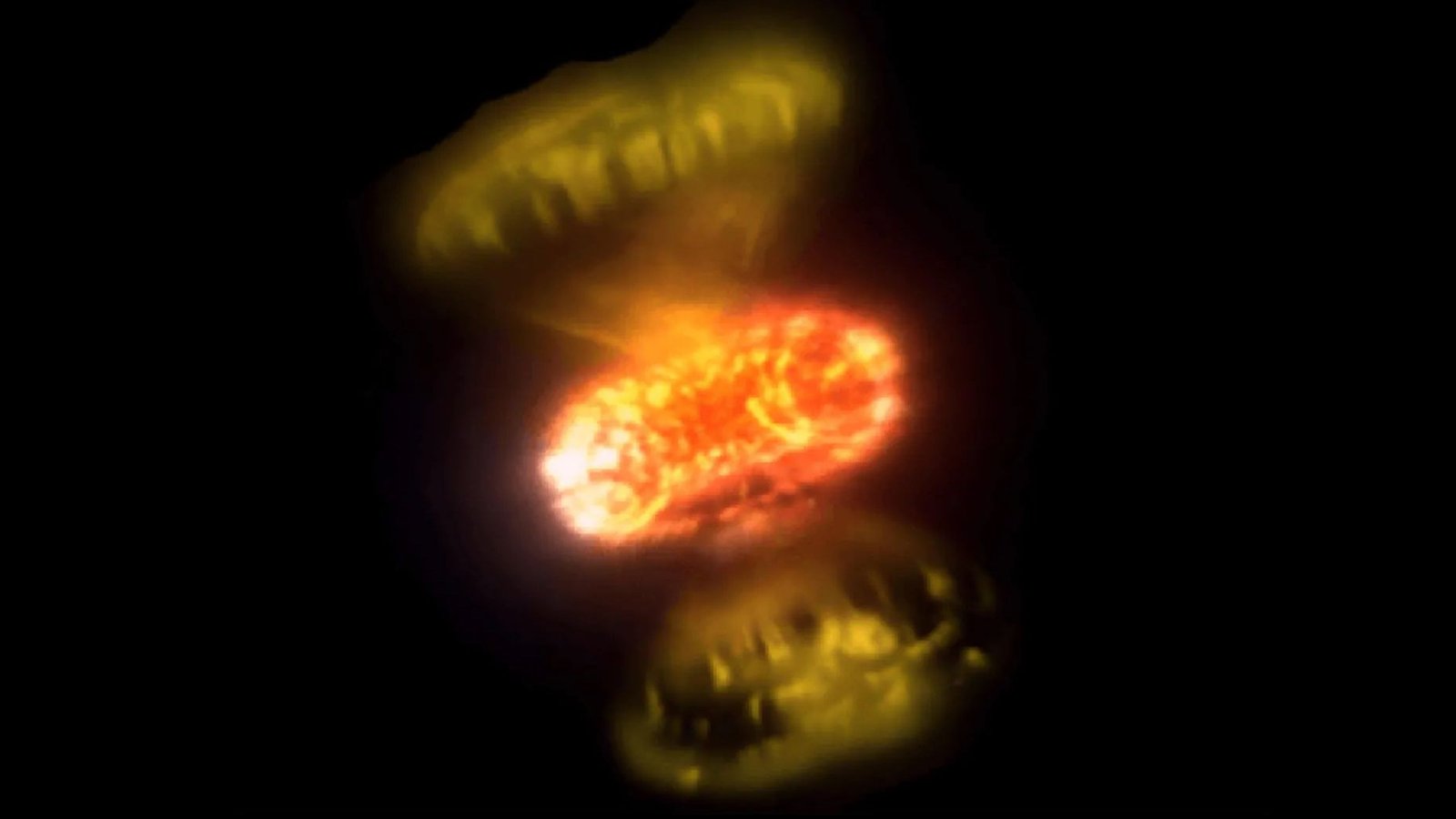
Using high-resolution near-infrared interferometry, astronomers have captured the first direct images of white dwarf explosions, revealing that these stellar eruptions are far more asymmetrical and complex than previously theorized. By documenting the immediate aftermath of “novae” in the Hercules and Cassiopeia constellations, the research team bypassed traditional indirect inference methods to witness the violent ejection of material in real-time within binary star systems.
Redefining Stellar Eruptions: The V1674 Herculis Case
Gail Schaefer, director of the CHARA Array, led the observations of V1674 Herculis and V1405 Cassiopeiae to understand how material escapes a star during a thermonuclear runaway. Historically named for the abrupt surge in luminosity that creates the illusion of a newborn star, a nova occurs when a white dwarf siphons hydrogen-rich gas from a companion star. V1674 Herculis proved to be one of the fastest events ever recorded, hitting peak brightness in less than 16 hours before fading within days.
The resulting imagery of V1674 Herculis shattered the assumption of spherical symmetry. The explosion produced two distinct ejecta flows toward the northwest and southeast, accompanied by an elliptical structure radiating perpendicularly. This visual evidence confirms that multiple layers of ejecta interact violently during the blast, rather than expanding as a uniform bubble.
Shock Waves and Gamma-Ray Detection
Spectroscopic data identified a significant velocity jump in hydrogen atoms during the V1674 Herculis event, which accelerated from 3,800 km/s to 5,500 km/s after the peak. This acceleration coincided with high-energy gamma rays detected by NASA’s Fermi Gamma-ray Space Telescope. The collision between these varying velocity streams created a powerful shock wave, effectively transforming the nova into a cosmic particle accelerator.
V1405 Cassiopeiae and the Common Envelope Mystery
In contrast to the rapid Herculis explosion, V1405 Cassiopeiae evolved slowly, taking 53 days to reach its maximum brightness and remaining luminous for nearly 200 days. Initial observations during the peak showed a central light source with a radius of approximately 0.85 astronomical units (au). This measurement revealed a massive discrepancy: had the outer hydrogen layer been ejected at the start of the explosion, it should have expanded to a radius between 23 and 46 au over those 53 days.
This data suggests that V1405 Cassiopeiae entered a “common envelope” phase, where the expanded gas trapped the entire binary system for several weeks. Eventually, the orbital motion of the two stars acted as a mechanical force, pushing the outer layers away and generating new shock waves and high-energy emissions as the material finally broke free from the system’s gravitational and orbital influence.
Novae as Natural Physics Laboratories
These discoveries redefine novae as complex laboratories for studying shock waves and particle acceleration. With the Fermi telescope identifying gamma rays in over 20 novae over the last 15 years, researchers can now analyze the detailed mechanisms of how stars interact in close proximity—a process occurring in more than 10 percent of the stars in the universe. Near-infrared interferometry has opened a new window into the true, chaotic nature of these dramatic celestial phenomena, proving they are far richer and more scientifically significant than simple explosions.