
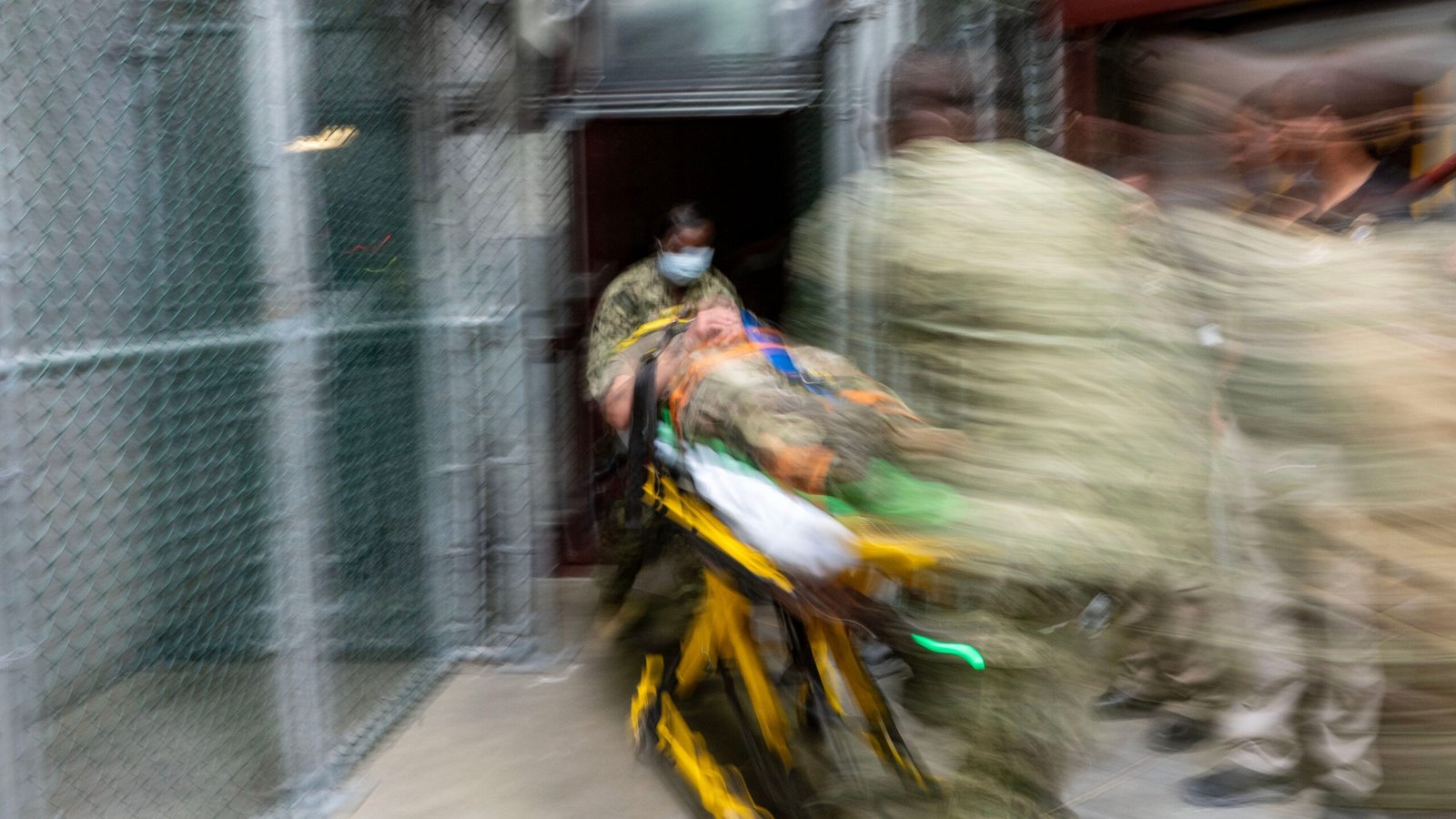
Uniformed healthcare professionals are abandoning the U.S. Public Health Service (PHS) to protest mandatory deployments to Guantánamo Bay, where the federal government is now detaining immigrants in high-security facilities once reserved for terror suspects. These resignations highlight a growing rift between federal immigration mandates and the medical ethics of the nation’s 5,000 commissioned health officers, who typically serve as the frontline response for domestic emergencies like hurricanes and disease outbreaks.
A Crisis of Conscience in the Uniformed Corps
For officers like Stewart, a nurse with a decade of service, the order to report to Cuba represented an impossible choice. Despite the prospect of losing a pension guaranteed after 20 years, she resigned her commission. Stewart described the situation as a “man-made humanitarian crisis,” noting that her previous experiences at Customs and Border Protection facilities in Texas—where 50 women were held in single concrete cells—informed her decision to refuse further participation in the detention apparatus.
Similarly, Dena Bushman, a nurse formerly embedded with the Centers for Disease Control and Prevention (CDC), resigned after grappling with the moral implications of the assignment. Bushman compared the logistical support of such detention centers to historical atrocities, stating she could not reconcile her professional oath with the reality of the mission. While some officers have secured medical waivers due to stress, others have chosen to leave the service entirely rather than facilitate the current administration’s mass detention strategy.
Inside the “Dark Prison”: Conditions at Camp 6
Public health officers who served at the base over the past year describe harrowing conditions for detainees. Many immigrants are held in Camp 6, a high-security facility designed to prevent natural light from entering. Officers, speaking under the condition of anonymity to avoid retaliation, revealed that many detainees were unaware they had been moved to Cuba until they were informed by medical staff.
The population at the base is largely classified as “low-risk.” A May progress report from a chaplain observing the detainees noted that 90 percent of the men had no criminal convictions. Despite Homeland Security Secretary Kristi Noem’s assertion that Guantánamo would hold “the worst of the worst,” internal data suggests the facility is being used to house noncitizens who previously lived in the U.S. without incident.
The Logistical Nightmare of Offshore Care
Providing medical care in a military prison environment presents unique challenges. Lab results that take hours in the United States often take weeks at Guantánamo. While the base offers amenities like snorkeling and yoga for military personnel, the detained population remains trapped in a system fraught with sleep deprivation and the psychological trauma of indefinite uncertainty. PHS officers reported that requests for specialized care are frequently denied due to the immense logistical hurdles of transporting detainees back to the mainland.
The Staggering Financial and Human Cost
The decision to use Guantánamo Bay as an immigration annex carries a massive fiscal burden. Analysis of Department of Defense data indicates that detaining an individual at the base costs approximately $16,540 per day. In contrast, detention within ICE facilities on U.S. soil costs roughly $157 per day.
This spending surge coincides with record-breaking budgets for immigration enforcement. Congress allocated $78 billion to ICE for fiscal year 2026, a massive increase from the $9.9 billion seen in 2024. Furthermore, the administration diverted over $2 billion from the national defense budget to fund immigration detention, with $60 million specifically earmarked for Guantánamo operations.
Command Authority vs. Professional Ethics
The leadership of the Public Health Service maintains a rigid stance on these deployments. Admiral Brian Christine, the Assistant Secretary for Health and a former urologist specializing in male fertility, dismissed concerns regarding subjective morality. “Our duty is clear: say ‘Yes Sir!’, salute smartly, and execute the mission,” Christine stated, arguing that refusing assignments risks abandoning the individuals the service is pledged to help.
However, medical experts like retired Army General and psychiatrist Stephen Xenakis warn that sending health workers into these environments without clear protocols is dangerous. Xenakis points to a 2014 incident where a Navy nurse faced court-martial for refusing to participate in the painful force-feeding of hunger-striking prisoners. Without transparency regarding standard operating procedures, Xenakis argues, medical professionals cannot truly understand the ethical weight of the duties they are expected to perform.
As the administration continues to expand its detention network, the drain on PHS resources may impact national security. Anne Schuchat, a 30-year veteran of the service, warned that diverting these officers to detention centers reduces the nation’s capacity to respond to genuine public health emergencies, potentially leaving the public vulnerable during future crises.