U.S. Immigration and Customs Enforcement (ICE) Acting Director Todd Lyons issued a superseding memorandum on May 27 that removes requirements for federal agents to respect local and state statutes during courthouse arrests, signaling a significant escalation in the administration’s mass deportation campaign. The revised policy, recently updated on the agency’s website, grants federal officers unprecedented autonomy to conduct enforcement actions in sensitive legal environments without consulting legal advisers regarding nonfederal jurisdictional restrictions.
Dismantling Legal Guardrails for Federal Agents
The new directive effectively nullifies interim guidance issued in January by former acting director Caleb Vitello, which had explicitly ordered agents to ensure courthouse arrests were “not precluded by laws imposed by the jurisdiction” of the action. By removing this language, the Lyons memo eliminates the necessity for ICE personnel to verify if an arrest violates local protections designed to keep courthouses accessible to the public regardless of immigration status.
Anthony Enriquez, vice president at RFK Human Rights, warns that this shift leaves complex legal determinations to the discretion of individual officers. “The old policy required ICE to consult with a legal adviser to determine whether making an arrest at or near a courthouse might violate a nonfederal law,” Enriquez stated. He noted that these decisions now fall to line officers who lack training in the nuances of local statutes.
A Departure from Biden-Era Enforcement Limits
This policy pivot represents a stark reversal of the 2021 Biden administration protocols, which sought to limit courthouse arrests due to their “chilling effect” on witnesses and victims. Under previous rules, enforcement at courthouses was generally restricted to matters of national security or immediate public safety threats. The current administration has moved to dismantle these barriers, returning to—and expanding upon—2018 guidance that prioritized courthouse-based apprehensions.
Emma Winger, deputy legal director at the American Immigration Council, characterizes the move as an intentional effort to “unleash and expand ICE’s enforcement operations without regard to state law.” While federal policy guidance does not carry the same weight as statutory law, it serves as the operational mandate that dictates how agents function on the ground.
Aggressive Quotas and Public Confrontations
The policy change coincides with reports of intensified pressure from the highest levels of the Department of Homeland Security (DHS). According to Axios, Trump deputy chief of staff Stephen Miller and DHS Director Kristi Noem recently directed ICE to achieve a quota of 3,000 deportations per day. This aggressive target has already manifested in high-profile operations and public friction.
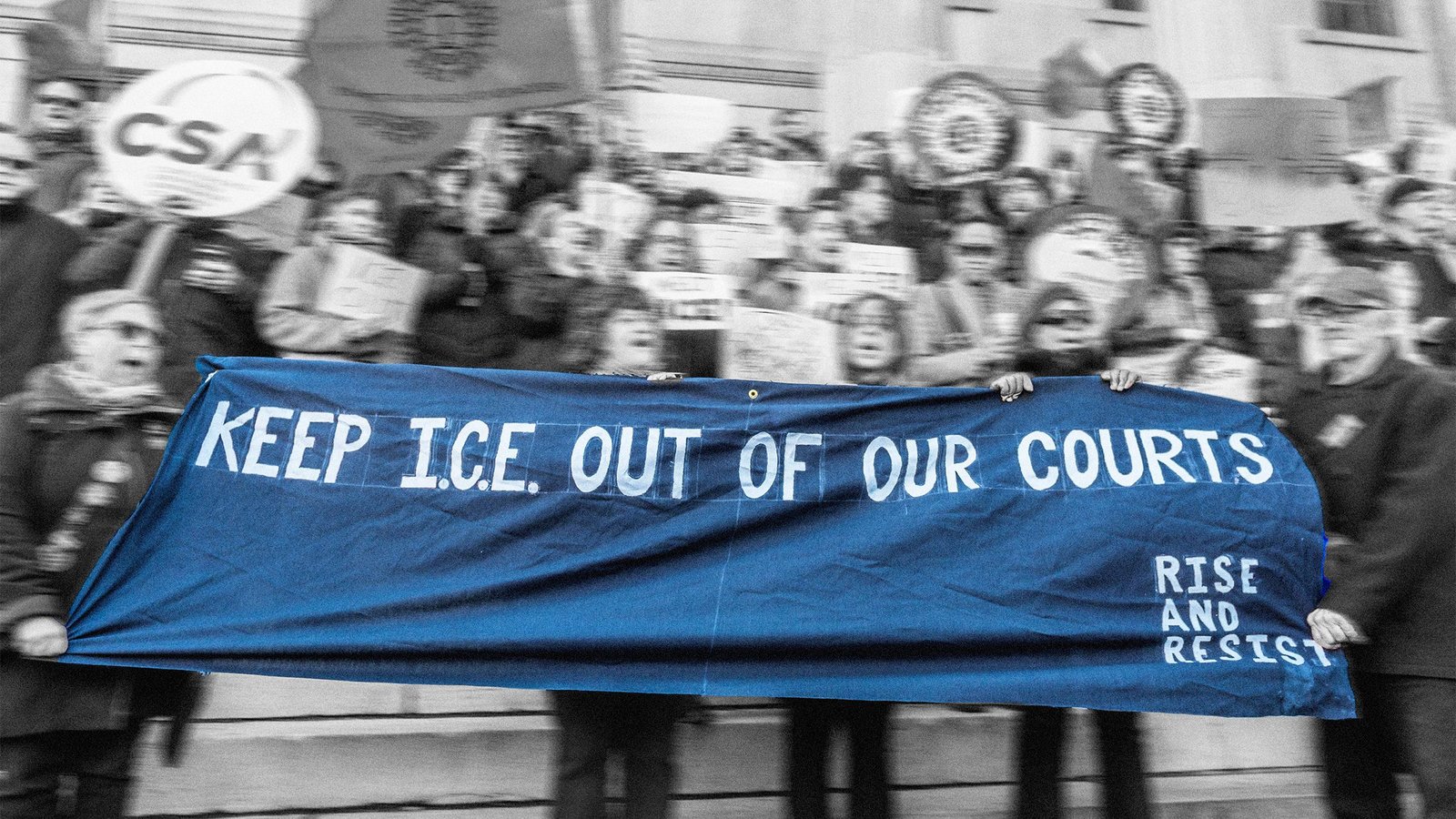
In San Diego, ICE agents recently utilized flash-bang devices to disperse crowds during a confrontation outside a local restaurant. Acting Director Lyons defended the agents’ use of masks to conceal their identities during the incident. Meanwhile, in New York City, agents arrested at least a dozen individuals at courthouses last month, including a Bronx high school student. These actions occurred despite New York state law prohibiting civil arrests at courthouses without a judicial warrant—a protection the new ICE memo appears designed to circumvent.
Legal Blowback and State Sovereignty
The federal government’s encroachment on local legal systems has already triggered litigation. The City of New York filed a lawsuit this week against Lyons, Noem, and ICE, seeking the release of the detained Bronx student and challenging the legality of the arrest. Legal experts anticipate similar challenges in states like Colorado, which have enacted specific protections for sensitive locations.
The tension between federal enforcement and municipal autonomy was further highlighted last week when DHS briefly published, then retracted, a list of “sanctuary jurisdictions” it deemed non-compliant with federal goals. Enriquez views the May 27 memo as a direct assault on state sovereignty. “We should expect to see legal challenges to the federal government’s encroachment,” he said, warning that the policy shift will ultimately result in “less justice in our local and state courts” as migrants fear entering judicial buildings.