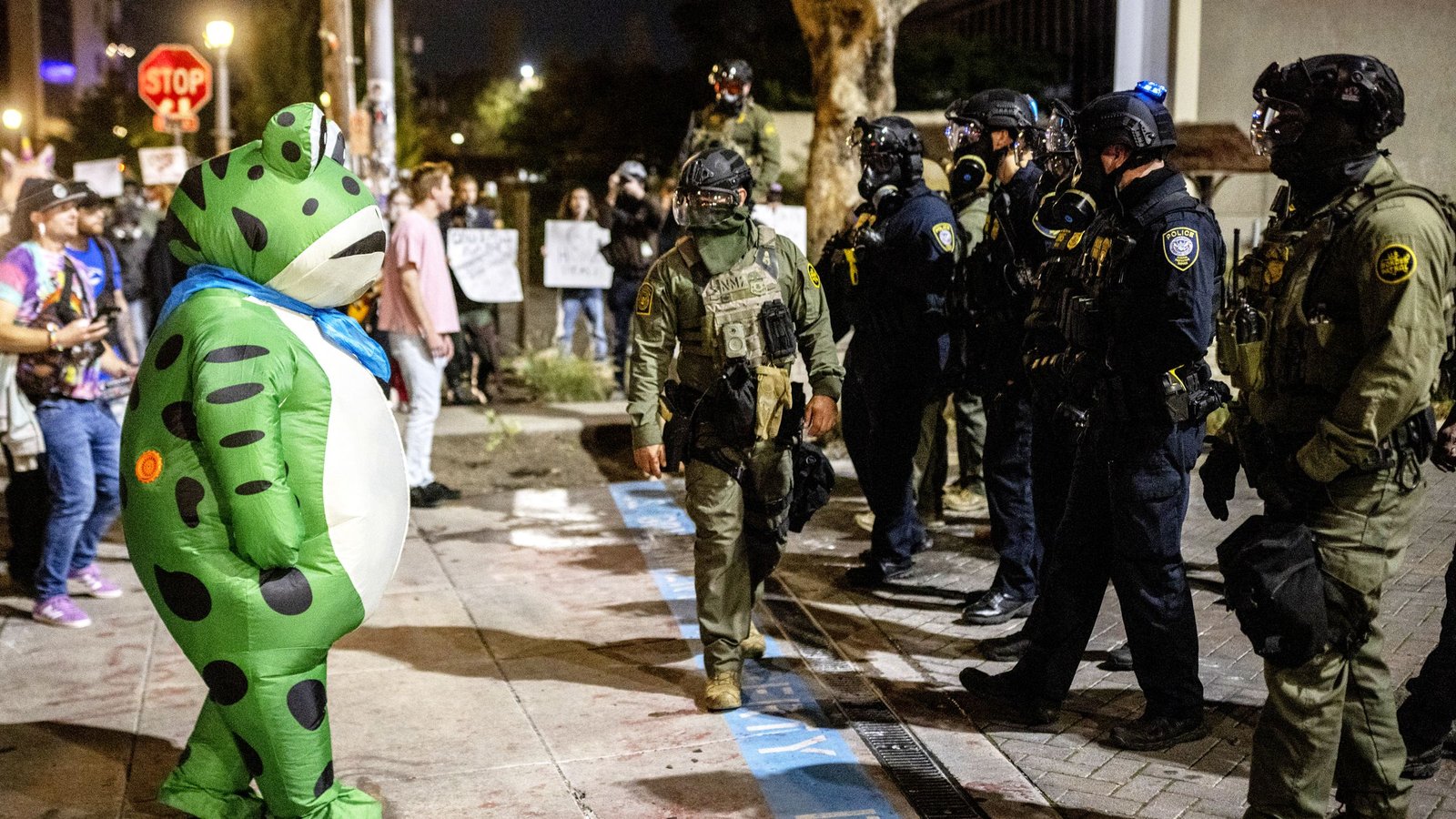
Protesters across major U.S. cities are deploying inflatable frog costumes to neutralize political narratives and evade surveillance, transforming a viral meme into a high-stakes tool of civil disobedience. This tactical shift, which gained traction at an Immigration and Customs Enforcement (ICE) facility in Portland, Oregon, has rapidly scaled into a nationwide phenomenon known as “Operation Inflation,” appearing in demonstrations from Los Angeles to Charlotte.
Operation Inflation: Scaling the Viral Resistance
The movement accelerated after images of demonstrators holding “Frogs Together Strong” signs saturated platforms like TikTok, Instagram, and Bluesky. What began as a localized act by activist Seth Todd has evolved into a sophisticated logistics operation. Brooks Brown, a YouTuber and co-initiator of Operation Inflation, partnered with fellow streamers to fund and distribute over 300 inflatable outfits, including 200 during the recent “No Kings” protest.
Supply chain challenges have emerged as the demand for green amphibians spikes. Brown notes that the group now coordinates directly with primary suppliers to secure inventory as prices fluctuate on secondary markets. “The capitalism side of this is really fascinating,” Brown remarked, highlighting the competitive nature of sourcing these symbols of dissent to prevent opponents from cornering the market.
The Tactical Utility of the Inflatable Suit
Beyond the visual spectacle, these costumes serve three critical strategic functions: anonymity, narrative control, and psychological de-escalation. As facial recognition technology becomes a standard tool for law enforcement, the oversized green suits provide a layer of protection, making individual identification nearly impossible as more participants adopt the uniform.
Furthermore, the absurdity of the costumes directly challenges the “violent extremist” label often applied to demonstrators by political figures. Seth Todd noted that the choice was deliberate: to contrast the image of black-clad archetypes with something inherently non-threatening. Brooks Brown argues that the costumes alter the public’s perception of police force. “It breaks people’s ability to justify the victim,” Brown explained, suggesting that the public finds it significantly harder to rationalize the use of pepper spray against a cartoonish figure than a standard protester.
Reclaiming a Contested Cultural Icon
The use of frogs represents a sophisticated cultural reclamation. In 2016, Pepe the Frog was designated a hate symbol after being co-opted by alt-right groups. However, the 2019 pro-democracy protests in Hong Kong began rehabilitating the image, using the amphibian as a symbol of resistance against authoritarianism. The current American movement leans into this shift; recent social media imagery depicts the inflatable protest frogs physically striking the alt-right version of Pepe, signaling a definitive break from the character’s extremist associations.
Legal Battles and the “War Zone” Label
The political weight of the movement recently reached the federal bench. The U.S. Court of Appeals for the Ninth Circuit voted 2-1 to lift a block on the deployment of National Guard troops to Portland. This ruling follows executive characterizations of the city as being in a state of “anarchy,” a narrative reinforced by AI-generated videos shared by the administration to disparage demonstrators.
In a pointed dissent, Judge Susan Graber criticized the majority’s acceptance of the government’s “war zone” characterization. Graber highlighted the “well-known penchant” of Portland protesters for wearing chicken suits and inflatable frog costumes. She argued that viewing a landscape populated by such costumes as a combat zone is “merely absurd,” siding with the perspective that the theatrical nature of the protests undermines the justification for military-style intervention.