
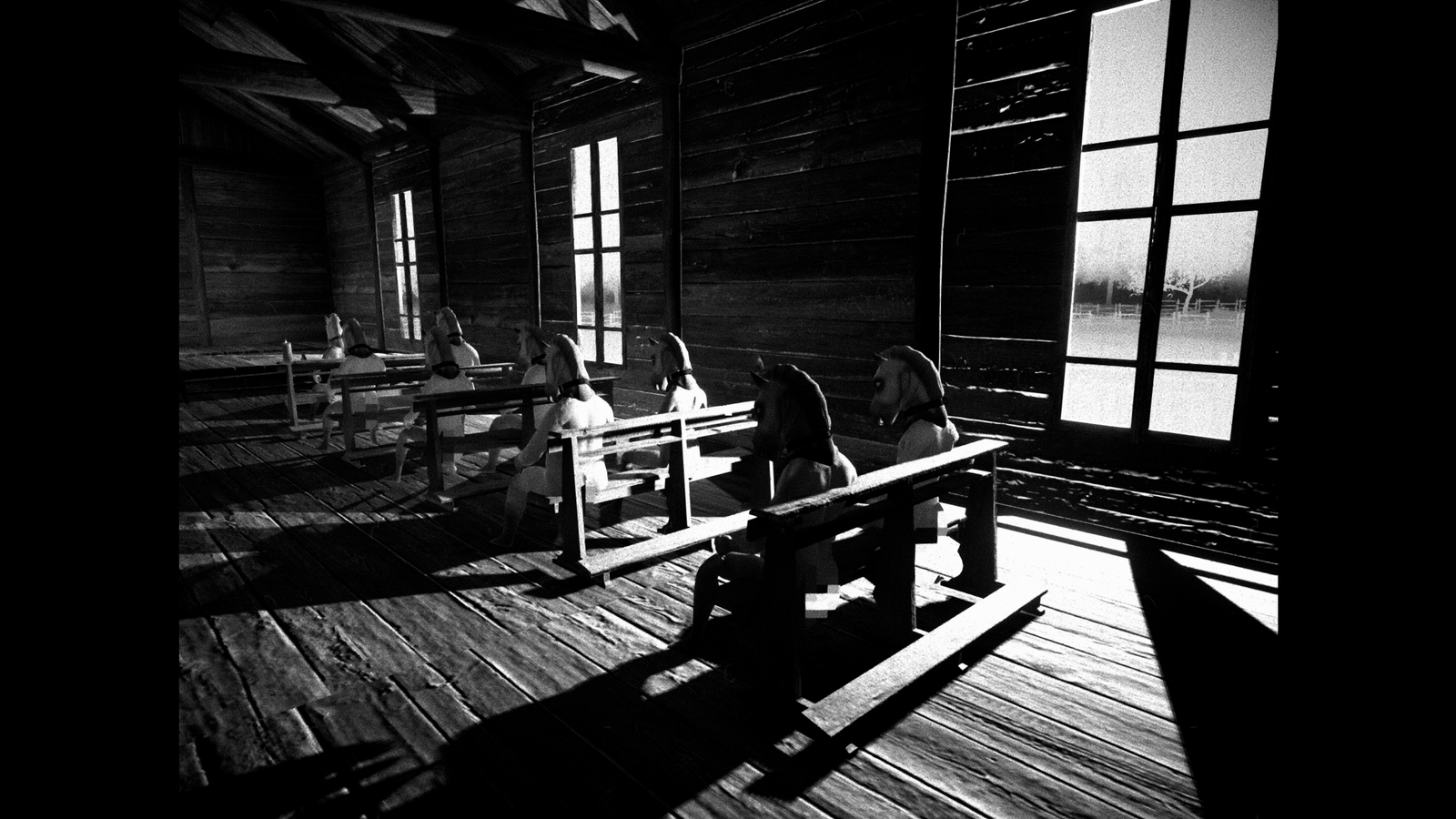
Santa Ragione’s psychological horror title Horses has dominated industry headlines this year following its aggressive delisting from major distribution platforms, yet the game’s mechanical failures and clumsy handling of trauma ultimately overshadow its status as a free-speech flashpoint. While the public and developer communities have rallied against the perceived censorship of the title, a critical examination reveals a product that relies more on shock value and pseudo-intellectualism than cohesive storytelling or meaningful social commentary.
The Thin Line Between Art and Provocation
The discourse surrounding Horses has largely focused on the ethics of platform gatekeeping. Critics of the ban argue that distribution giants wield excessive power over small studios, potentially stifling creative expression. However, this narrative often ignores the actual experience of playing the game. Despite its reputation as a “dangerous” piece of media, Horses functions as a tedious three-hour slog that confuses pretension with profundity. Its attempt to shock the player eventually loses momentum, leaving behind a hollow experience that mirrors the aesthetic of a subpar student film rather than a groundbreaking psychosexual drama.
A Descent Into Human Subjugation
The narrative places players in the role of a farmhand tasked with a 14-day residency on a remote property. Daily chores—harvesting vegetables, maintaining the grounds, and feeding the livestock—mask a sinister reality. The titular “horses” are not animals, but naked human beings wearing masks, chained and stripped of their humanity. The “dog” follows a similar pattern of degradation. The farmer demands absolute control over these captives, forcing the player to enforce a brutal regime of labor and “chastity” through whatever means necessary.
Mechanical Tedium and Visual Dissonance
The game utilizes a low-fidelity, black-and-white aesthetic reminiscent of early cinema to create a surreal atmosphere. However, the uncanny-valley character models and “dead-eyed” stares often shift the tone from horrific to harebrained. While the game features pervasive nudity, pixelated genitals prevent it from crossing into explicit pornography. Instead, it relies on animalistic depictions of sex and labor to drive home its themes of subjugation—a point it hammers with the subtlety of a sledgehammer.
The Failure of Critical Engagement with Trauma
The most significant failure of Horses lies in its treatment of sexual violence. The game depicts multiple instances of sexual assault, yet it treats these moments as mere texture for its horror setting rather than subjects for serious exploration. By using rape as a plot device to illustrate the farmer’s religious trauma and fetishistic shame, the narrative fails to provide the intention or care required for such sensitive material. Rather than confronting the trauma it inflicts on its characters, the story uses violence as a shortcut to establish brutality, offering no moral resolution or meaningful insight by its conclusion.
Platform Monopoly and the Developer’s Dilemma
The controversy has sparked a broader conversation about the economic vulnerability of independent creators. Jakin Vela, executive director of the International Game Developers Association (IGDA), highlights that the current industry consolidation creates a structural imbalance. “We should be concerned whenever a system allows a creator’s livelihood to be cut off without transparency or recourse,” Vela notes, emphasizing that the lack of viable alternatives to major platforms leaves developers in a precarious position.
Despite the bans on mainstream storefronts, the “Streisand effect” has turned Horses into a top-seller on alternative platforms like GOG. While the right of the game to exist remains a valid point of defense, its commercial success does not absolve its creative failings. The industry must separate the fight against censorship from the critical assessment of the work itself; Horses may deserve its place on the shelf, but it has yet to prove it deserves the player’s time.