Offshore workers aboard the specialized recovery vessel MV Maasvliet are currently extracting over 1,000 kilometers of the historic TAT-8 fiber-optic cable from the Atlantic seabed, marking the final decommissioning of the infrastructure that revolutionized global digital communication in 1988. This operation, led by the firm Subsea, represents the closing chapter for the first transoceanic system to utilize light pulses rather than copper-based electrical signals to bridge the gap between North America and Europe.
The Birth of a Global Light Beam
Launched on December 14, 1988, TAT-8 (Trans-Atlantic Telephone-8) was a joint venture between AT&T, British Telecom, and France Telecom. It represented a technological leap equivalent to galactic expansion. During its inaugural voyage, science fiction visionary Isaac Asimov addressed audiences in New York, London, and Paris via video link, hailing the event as a “maiden voyage across the sea on a beam of light.”
While the public and AT&T marketing focused on the end of the Cold War and the ability to book calls to Poland or Russia, the technical reality was even more radical. Based on theories developed in the 1960s and early terrestrial applications in the 1970s, TAT-8 turned voices into light pulsating across glass strands as thin as spiderwebs. One of the key figures behind fiber-optic transmission, English scientist Alec Reeves, notably balanced his engineering brilliance with interests in psychokinesis—a fittingly esoteric origin for technology that essentially moves information through the power of the mind’s inventions.
Debunking the Great Undersea Shark Myth
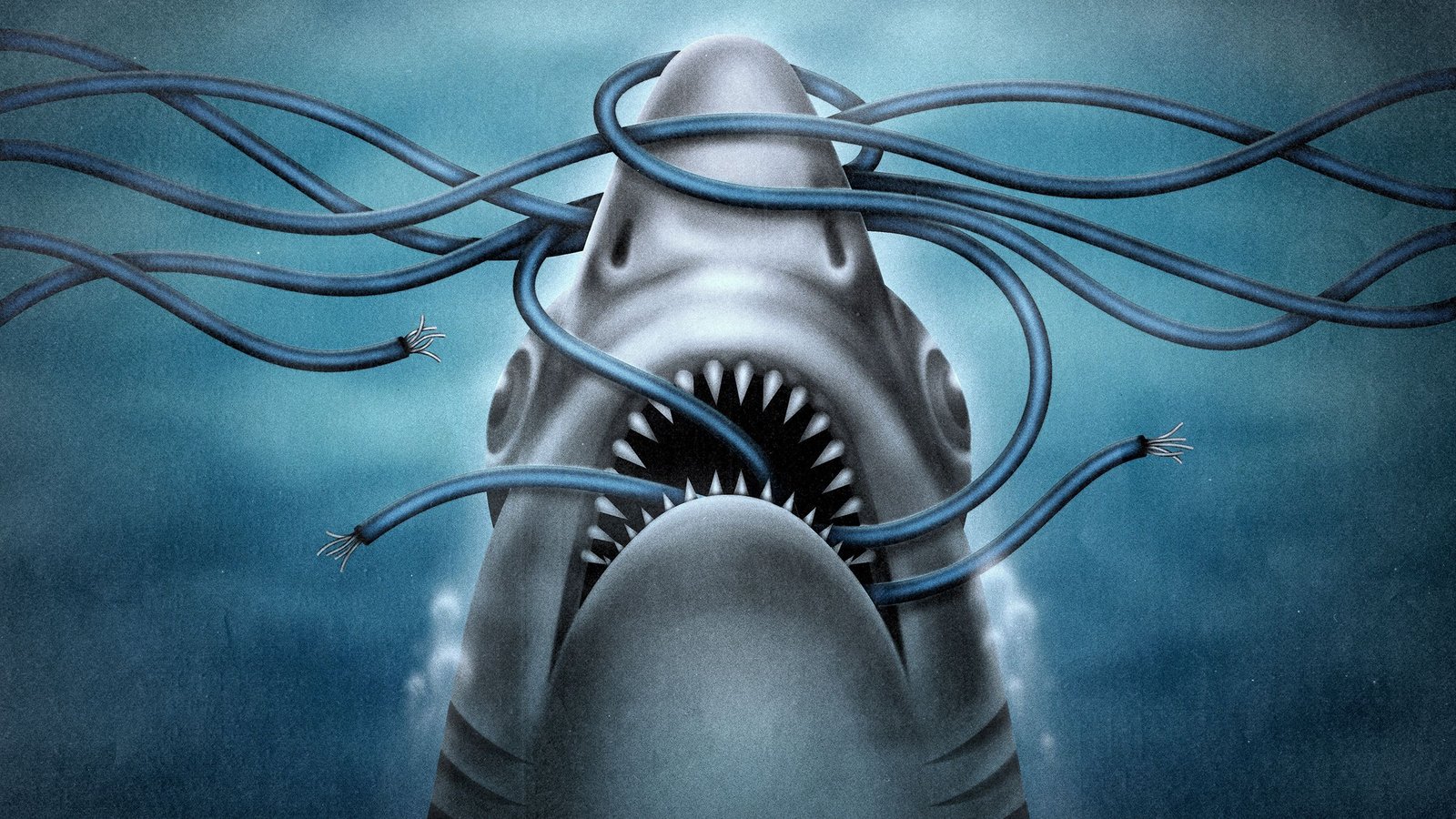
For decades, the narrative surrounding subsea cables has been dominated by the threat of shark attacks. This legend traces back to 1986 and the Optican-1 test system in the Canary Islands. When project manager Elaine Stafford and her team discovered “shunt faults”—damage to the insulation interrupting signals—they were initially baffled. The mystery was solved when Jack Sipress of Bell Labs produced actual shark teeth extracted from the damaged cable.
The industry reacted with a mix of fascination and fear. AT&T funded extensive research at aquariums in Connecticut and Florida, attempting to provoke dogfish and lemon sharks into biting cables emitting various electrical fields. The results were largely inconclusive. Despite the lack of evidence that sharks were actively hunting data, the engineers took no chances. TAT-8 was designed with a protective steel layer between the polyethylene insulation and the fibers—a feature now standard in the industry known as “fish bite protection.” Ironically, the sharks likely only bit the cables because they were suspended above the seafloor, resembling prey, yet their curiosity led to more resilient global infrastructure.
The Grueling Human Labor of Cable Recovery
The recovery of TAT-8 from the Portuguese port of Leixões reveals that maintaining the internet remains a deeply physical, human-centric endeavor. On the MV Maasvliet, a high-tech diesel-electric vessel running on industrial Volvo engines, the crew operates with a mix of modern sensors and ancestral maritime skills.
The most demanding role is that of the “coiler.” Because fiber-optic cable must be coiled by hand to prevent breakage, workers stand in the ship’s hold, walking in slow, backward circles for eight-hour shifts to stack the cable as it comes off the winch. It is dizzying, manual work performed in 30-degree Celsius heat while the ship tosses in the Atlantic swells. This institutional knowledge is passed down through veterans like Stephen, a coiler with 15 years of experience, who trains new recruits in the delicate art of handling “giant cooked spaghetti”—the nickname for the deep-sea cable sections that are roughly the diameter of a candle.
Fishing for History: The “Flatfish” Technique
Retrieving a cable from kilometers below the surface is akin to flying a kite in space. Engineers use a “route positioning list”—a detailed spreadsheet of every joint and splice made over the last 38 years—to locate the line. To snag the cable, they deploy a “flatfish” grapnel hook. The ship sails at a precise speed of one knot, dragging the hook across the seabed until the winch registers tension. When the “bite” is confirmed, the crew cheers—a tradition that has persisted since the 19th-century telegraph era.
From Seabed to Shampoo Bottles: The Circular Economy
Once the MV Maasvliet fills its tanks, the TAT-8 cable is transported to South Africa for processing at Mertech Marine, the world’s only dedicated cable recycling facility. The recovery is not merely a cleanup operation; it is a vital source of high-quality raw materials.
| Material | Future Use Case |
|---|---|
| High-Grade Copper | Industrial manufacturing (addressing global shortages) |
| Steel Shielding | Vineyard fencing and agricultural game barriers |
| Polyethylene | Non-food-grade plastics, such as shampoo bottles |
| Glass Fiber | Currently the only non-recyclable component |
With the International Energy Agency predicting copper shortages within a decade, the thousands of kilometers of TAT-8 represent a significant secondary mine. The polyethylene pellets derived from the cable’s insulation will eventually find their way into consumer products, completing a 38-year journey from the light-speed frontier of the Atlantic floor to everyday household items.
A Legacy of Institutional Knowledge
The subsea cable industry remains a tight-knit community of Generation X and Boomer experts who thrive on “messy problems.” While the original Bell Labs facility in Holmdel, New Jersey—where TAT-8 was tested—has been converted into a mixed-use complex (and a filming location for the series Severance), the human expertise persists. Veterans like 87-year-old Jean Devos and project manager Elaine Stafford represent a bridge to an era where connecting the world was a heroic, blank-check endeavor. As a new generation of talent is recruited to manage the “space junk” of the ocean floor, the recovery of TAT-8 serves as a reminder that the ethereal “cloud” has always rested on a very physical, very heavy foundation.