Lawrence Livermore National Laboratory technicians are currently dismantling and physically pulverizing the Sierra supercomputer, a former global leader in nuclear simulations, to safeguard national security secrets and clear floor space for its exascale successor, El Capitan. Once ranked as the world’s second-fastest machine, Sierra’s decommissioning marks the end of a decade-long journey that began in a Chicago conference room and concluded with a high-security execution protocol.
A Decade of Nuclear Dominance and Architectural Innovation
Engineers originally conceived Sierra as a “designer baby” for the National Nuclear Security Administration (NNSA). The machine utilized a then-daring architecture, combining thousands of IBM Power9 CPUs with Nvidia Volta V100 GPUs. This massive infrastructure occupied 7,000 square feet, spanning 240 individual racks that housed its processing core. Throughout its operational life, Sierra’s primary directive involved executing complex, high-security simulations critical to the United States’ nuclear stockpile.
Even at the moment of its “death sentence,” Sierra maintained a respectable position as the 23rd most powerful supercomputer globally. However, in the high-stakes environment of national defense, “respectable” performance eventually yields to the relentless demands of technological progress and hardware reliability.
The Bathtub Curve: Navigating Inevitable Hardware Decay
The decision to retire Sierra stems from the “bathtub curve” of hardware reliability—a phenomenon where failure rates are high at the start of a machine’s life, drop during a stable “golden era,” and spike again as components wear out. “As you age—just like humans—you are likely to get more disease,” explains Devesh Tiwari, a high-performance computing researcher at Northeastern University. “You are likely to fail more, so you need more caring and feeding.”
Beyond physical failure, obsolescence creates an insurmountable barrier. IBM and Nvidia no longer manufacture Sierra’s specific components, and Red Hat Enterprise Linux has ceased support for the version Sierra required. Ann Dunkin, former Chief Information Officer for the US Department of Energy, notes that while the lab might run infinite supercomputers with infinite resources, the reality of finite budgets and space necessitates a seven-year replacement cycle.
El Capitan: The 1.8 Exaflop Giant That Eclipsed Sierra
While Sierra achieved a peak performance of 94.64 petaflops, its successor, El Capitan, operates on an entirely different magnitude. Officially crowned the world’s fastest supercomputer in late 2025, El Capitan reaches 1.809 exaflops—roughly 19 times the speed of Sierra. This performance leap requires a massive 36 megawatts of power, enough to sustain 36,000 homes, compared to Sierra’s 11-megawatt draw.
Rob Neely, the lab’s associate director for weapons simulation and computing, admits that Sierra’s remaining “juice” no longer justified the “squeeze” of its operational costs. The internal architecture of El Capitan, featuring the AMD Instinct MI300A APU and unified memory, rendered Sierra’s once-revolutionary IBM-Nvidia hybrid obsolete.
The Execution Protocol: From Dehydration to Digital Erasure
The decommissioning of a nuclear supercomputer is a multi-phase operation. Technicians first executed digital scripts to shut down compute nodes and rack switches. Following the digital kill-switch, safety teams initiated a “dehydration” process, draining thousands of gallons of cooling water that previously surged through the machine’s internal plumbing. This water underwent rigorous pH testing to ensure environmental safety before disposal.
Unlike some supercomputers that find second lives in museums or universities—such as the Cheyenne system auctioned in 2024—Sierra’s classified history mandates total destruction. Because the machine processed top-secret data regarding the nation’s nuclear arsenal, the lab cannot risk any component being resuscitated or analyzed by adversaries.
Pulverized Secrets: The Violent End of High-Security Hardware
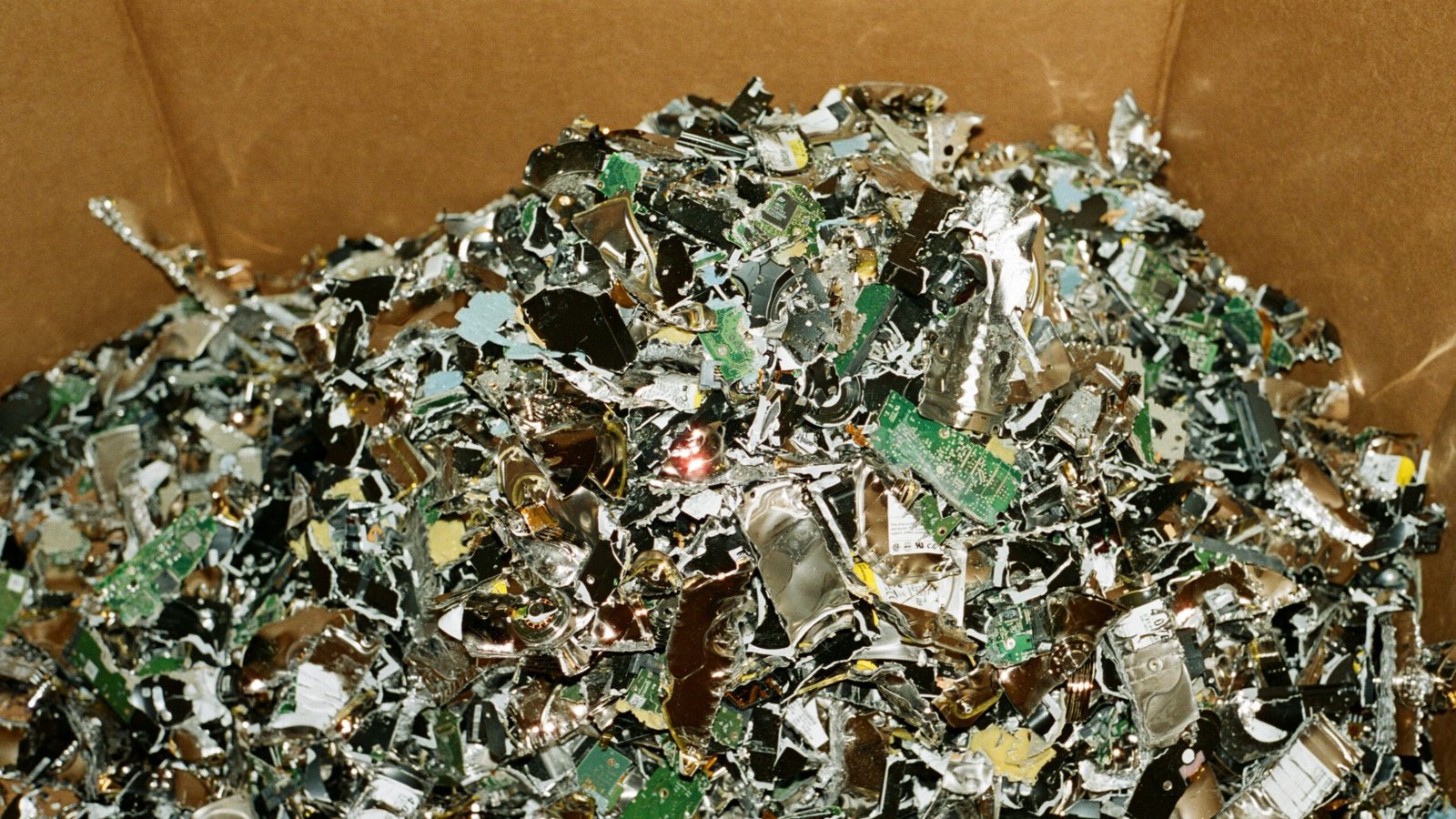
The physical destruction of Sierra is a meticulous and “bloody” process. Staff members manually extract lithium-ion batteries for specialized recycling before sending system boards, processors, and the skeletal steel racks to offsite industrial shredders. The goal is to reduce the hardware to a pulp, ensuring no data recovery is possible.
Flash memory components, which retain data without power, face an even more extreme fate: they are ground into a fine powder. For magnetic drives, the lab utilizes a government-approved degausser—a powerful permanent magnet capable of wiping credit cards and interfering with medical devices—to sanitize every bit of information. By the time the process concludes, electricians will sever the power lines permanently, leaving only the earthquake-resistant floor structures for the next generation of hardware.
The Future of High-Performance Computing Cycles
While some systems engineers, like Sandia National Laboratories’ Larry Baca, maintain a strictly unsentimental view of the hardware, others acknowledge the end of an era. Horst Simon, a veteran of the TOP500 rankings, emphasizes that while individual machines die, the field remains vibrant. However, a shadow looms over the industry: the potential slowdown of Moore’s Law. Some experts predict a future where hardware and software become so interchangeable that discrete “new” supercomputers disappear, replaced by continuous modular upgrades—or worse, a plateau where chip innovation no longer justifies the cost of replacement.
For now, the cycle continues. As one lab official noted, retiring a machine like Sierra is a necessary, if expensive, part of the technological lifecycle—much like the difficult discussions one has when a long-lived pet finally becomes too burdened by age to continue.