
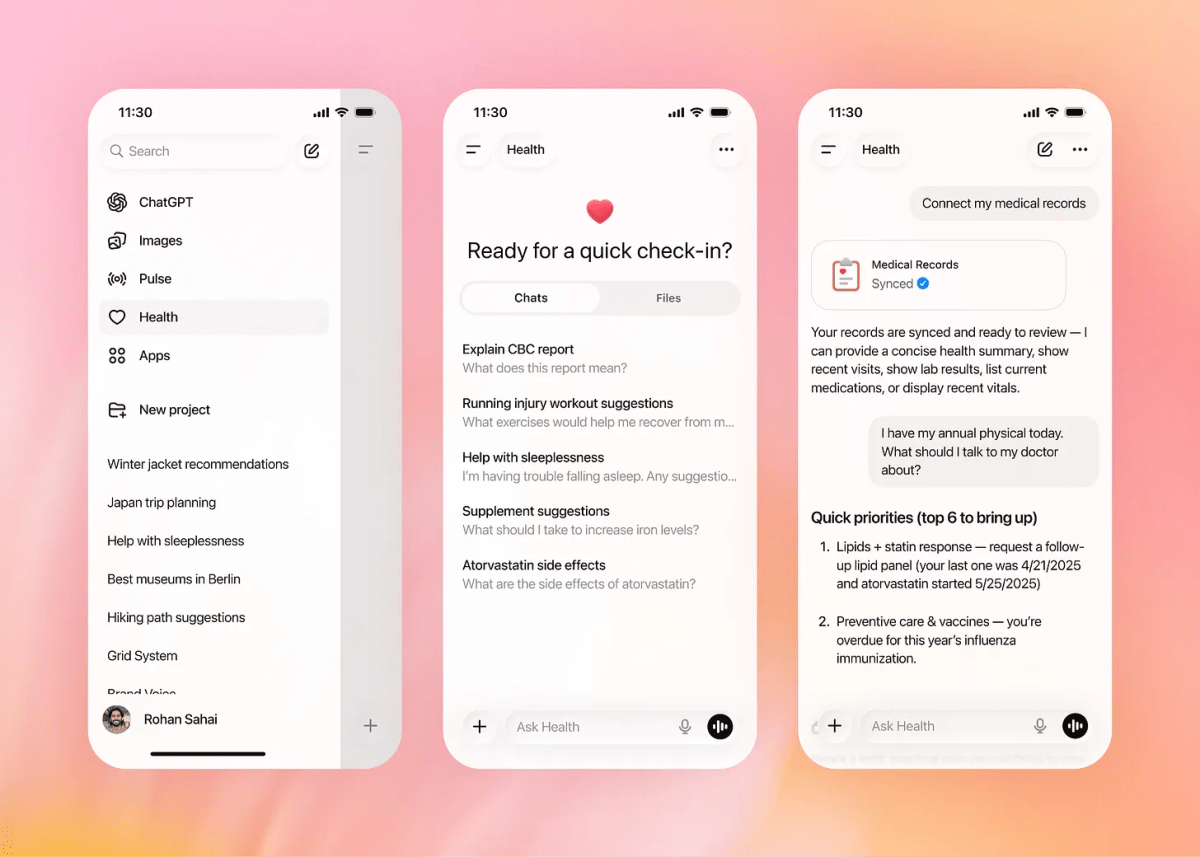
OpenAI launched ChatGPT Health this Wednesday, establishing a specialized hub for medical inquiries as over 230 million people currently turn to the AI for wellness guidance every week.
Privacy-First Architecture and User Guidance
To protect user privacy, the new interface separates health-related dialogues from standard chats. This architecture prevents medical context from influencing general interactions. If a user begins a health query in the main window, the AI prompts them to transition to the dedicated Health section to maintain data integrity.
Seamless Integration with Personal Health Data
The system maintains a sophisticated level of context. For example, if a user previously discussed marathon training in the standard interface, the AI retains that knowledge when discussing fitness goals within the Health portal. Furthermore, ChatGPT Health integrates directly with personal records from wellness ecosystems like Apple Health, Function, and MyFitnessPal. Crucially, OpenAI maintains that it does not utilize these health conversations to train its generative models.
Solving Systemic Gaps in Modern Healthcare
Fidji Simo, OpenAI’s CEO of Applications, detailed the initiative in a recent blog post. Simo positions ChatGPT Health as a strategic response to current healthcare barriers, including high costs, overbooked physicians, and the lack of consistent care continuity.
The Limitations of AI-Driven Medical Guidance
Despite its utility, AI-assisted health advice carries inherent risks. Large language models (LLMs) operate on predictive probability rather than a fundamental understanding of truth, making them susceptible to “hallucinations” or factual errors. OpenAI reinforces this limitation in its terms of service, stating the platform is not designed for the diagnosis or treatment of any medical condition. The feature will begin rolling out to users over the coming weeks.