
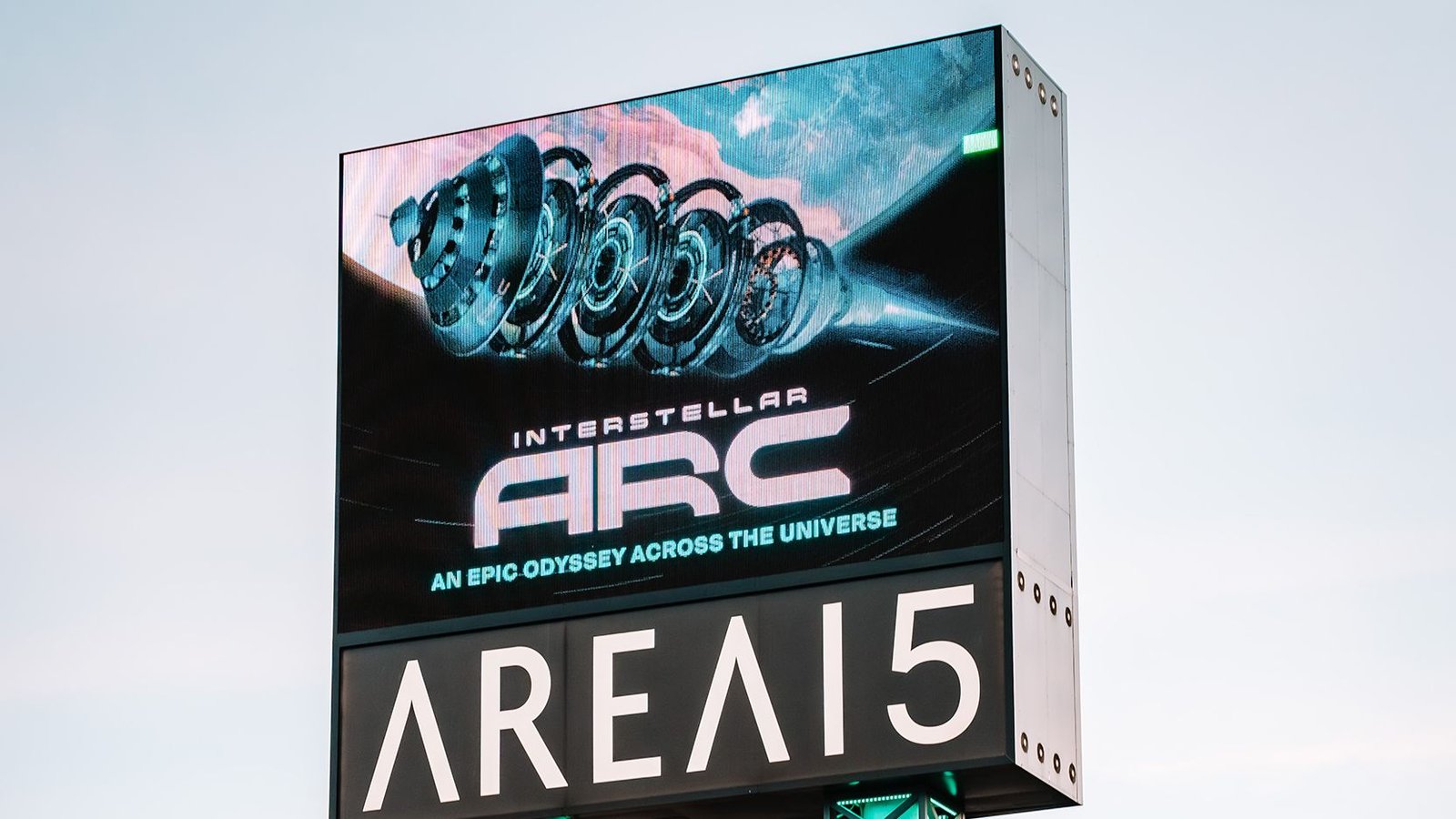
Felix & Paul Studios has launched “Interstellar Arc” at Las Vegas’s Area15 district, a massive location-based virtual reality experience that transports up to 170 simultaneous users to the 25th century using groundbreaking spatial redirection technology and a digital resurrection of Carl Sagan. This ambitious installation represents a pivotal shift in immersive storytelling, leveraging hardware like the Meta Quest 3S to solve the long-standing “scale problem” that has restricted VR to cramped living rooms for over a decade.
From the ISS to Arcadia: The Felix & Paul Pedigree
The project stems from the creative vision of Felix & Paul Studios cofounders Paul Raphaël, Félix Lajeunesse, and Stéphane Rituit. After transitioning from traditional filmmaking to VR in 2013, the team established themselves as pioneers by developing the first 360-degree space-rated camera. Their portfolio includes collaborations with NASA, the Obama White House, and Cirque du Soleil, earning multiple Emmy awards. Interstellar Arc evolves their previous work on “Space Explorers: The Infinite,” which utilized footage captured directly from the International Space Station to simulate the vacuum of space for terrestrial audiences.
For a ticket price of $54 ($39 for children), participants enter a “spaceport” lobby before embarking on a mission to the exoplanet Arcadia. The journey begins with a simulated 262-year cryogenic sleep, eventually depositing travelers into Cosmopolis, a sprawling man-made orbital centrifuge city. The experience blends physical infrastructure with digital hallucination, using real-world railings to ground users as they navigate a translucent skeleton overlooking a dual-colored alien world.
Engineering the Illusion: Walking Miles in a Single Room
The most significant technical achievement of Interstellar Arc lies in its “redirection” algorithms. While the physical facility spans 20,000 square feet—roughly the size of a hotel ballroom—participants frequently walk over a quarter-mile during the hour-long session. Paul Raphaël explains that the software subtly rotates the headset’s internal cameras, “cheating” the user’s perception to make flat ground feel like sloped or curved terrain. This allows the studio to re-map physical space into a much larger virtual environment, effectively creating a functional “holodeck.”
To prevent the motion sickness common in VR, the team spent 18 months refining these redirection windows, ensuring that visual “cheats” occur in short, balanced bursts. Andy Etches, founder of the VR firm Rezzil, notes that this approach is unique in the industry. Unlike omnidirectional treadmills that often feel unnatural, Interstellar Arc allows for organic movement that alters the participant’s perception of distance and elevation without physical hardware interference.
The Sagan Connection: Preserving Humanity’s Legacy
Central to the narrative is a 10-story-tall hologram of the legendary astronomer Carl Sagan. Serving as the “Librarian” of Cosmopolis, the digital Sagan discusses the preservation of Earth’s knowledge and references the Golden Record—the phonograph discs launched aboard the Voyager spacecraft in 1977. The inclusion of Sagan was more than a tribute; Felix & Paul Studios collaborated directly with the Sagan estate to ensure the dialogue mirrored the astronomer’s authentic philosophy.
The production team utilized a look-alike actor and sophisticated VFX post-production processes to recreate Sagan’s likeness. By comparing the results against archival footage, they achieved a high-fidelity digital twin that serves as both a guide and a thematic anchor for the interstellar mission, bridging 20th-century scientific optimism with 25th-century science fiction.
Overcoming the Latency and Crowding Barrier
Managing 170 people in a single virtual space presents a chaotic technical challenge for standard VR sensors, which typically struggle to maintain positioning in crowded environments. To eliminate “drifting” or digital “bouncing,” the studio equipped each Meta Quest 3S headset with an upward-facing camera. This sensor locks onto an infrared light grid on the ceiling that functions as a massive, room-wide QR code. This proprietary positioning system ensures that every participant remains perfectly synced within the shared reality.
As the VR industry seeks wider mainstream adoption, attractions like Interstellar Arc serve as a powerful proof of concept. By providing high-end experiences that are impossible to replicate at home, Felix & Paul Studios are not just creating entertainment; they are building a scalable blueprint for the future of virtual work, training, and exploration. As hardware becomes lighter and more powerful, the techniques pioneered in this Las Vegas warehouse may soon define how we interact with digital spaces on a global scale.