
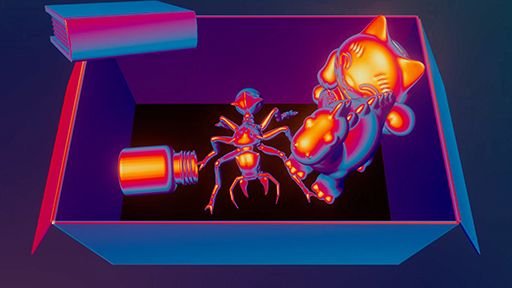
Quantum mechanics dictates that a truly empty box is a physical impossibility, as an unavoidable residue known as zero-point energy ensures that even a perfect vacuum at absolute zero remains filled with fluctuating activity. This fundamental phenomenon, first theorized by Max Planck in 1911, originates from the Heisenberg uncertainty principle, which prevents any system from achieving absolute rest by requiring a minimum level of kinetic and potential energy in every corner of the universe.
The Heisenberg Barrier to Absolute Stillness
In the classical world, an object at the bottom of a valley sits perfectly still, possessing zero kinetic energy. Quantum physics shatters this intuition. To reach a state of true zero energy, an object would need a precisely defined position and a velocity of exactly zero. However, the Heisenberg uncertainty principle forbids this level of precision. Consequently, atoms and molecules retain a “jiggle” even when cooled to the brink of absolute zero.
This ground-state energy manifests in two primary ways: as vibrations within discrete objects, such as atoms held by electric fields, and as fluctuations within universal fields, including the electromagnetic field. While physicists can dampen these vibrations, they cannot eliminate the underlying field presence. The result is a universe where “nothingness” is physically unattainable.
From Einstein’s Theories to 2025 Breakthroughs
Albert Einstein was among the first to recognize the profound implications of Planck’s discovery. Early theorists used zero-point energy to explain why liquid helium refuses to solidify under ordinary pressure, even at extreme temperatures that should theoretically lock atoms into a rigid lattice. These subtle, persistent vibrations keep the substance in a fluid state.
Modern technology has now allowed scientists to observe this “jiggling” directly. In 2025, researchers at the European X-Ray Free-Electron Laser Facility near Hamburg conducted a landmark experiment using iodopyridine, an organic molecule composed of 11 atoms. After cooling the molecule to near absolute zero, the team used high-intensity laser pulses to sever its atomic bonds. Experimental physicist Rebecca Boll reported that the freed atoms exhibited correlated motions, proving the molecule was vibrating even in its lowest possible energy state.
The Casimir Effect and the Gravity Paradox
One of the most tangible proofs of vacuum energy is the Casimir effect, predicted by Hendrick Casimir in 1948 and definitively measured in 1997. When two electrically uncharged metal plates are placed in close proximity, they experience an attractive force. This occurs because the plates act as a “guillotine” for electromagnetic waves, restricting long-wavelength oscillations between them while allowing a full spectrum of energy to exert pressure from the outside. This energy differential literally pushes the plates together.
However, this energy presents a massive theoretical crisis for gravity. Quantum field theory suggests that every field contains an infinite number of oscillators, implying the vacuum should hold an infinite amount of energy. Wolfgang Pauli noted in 1946 that such a gargantuan energy density should create a gravitational field powerful enough to cause the universe to explode. Sean Carroll, a physicist at Johns Hopkins University, emphasizes that because all energy gravitates, the fact that vacuum energy remains “muted” in our cosmic expansion is one of the greatest mysteries in modern physics.
The Vacuum as a Blueprint for Reality
Rather than a sterile void, the quantum vacuum is a reservoir of potential. Peter Milonni of the University of Rochester explains that the vacuum contains “electronness” even when no electrons are present. Every known particle and field is represented within this zero-point energy. In this framework, the vacuum is not merely the absence of things, but a fundamental state infused with the potential to manifest every form of matter in the universe, including particles yet to be discovered.