
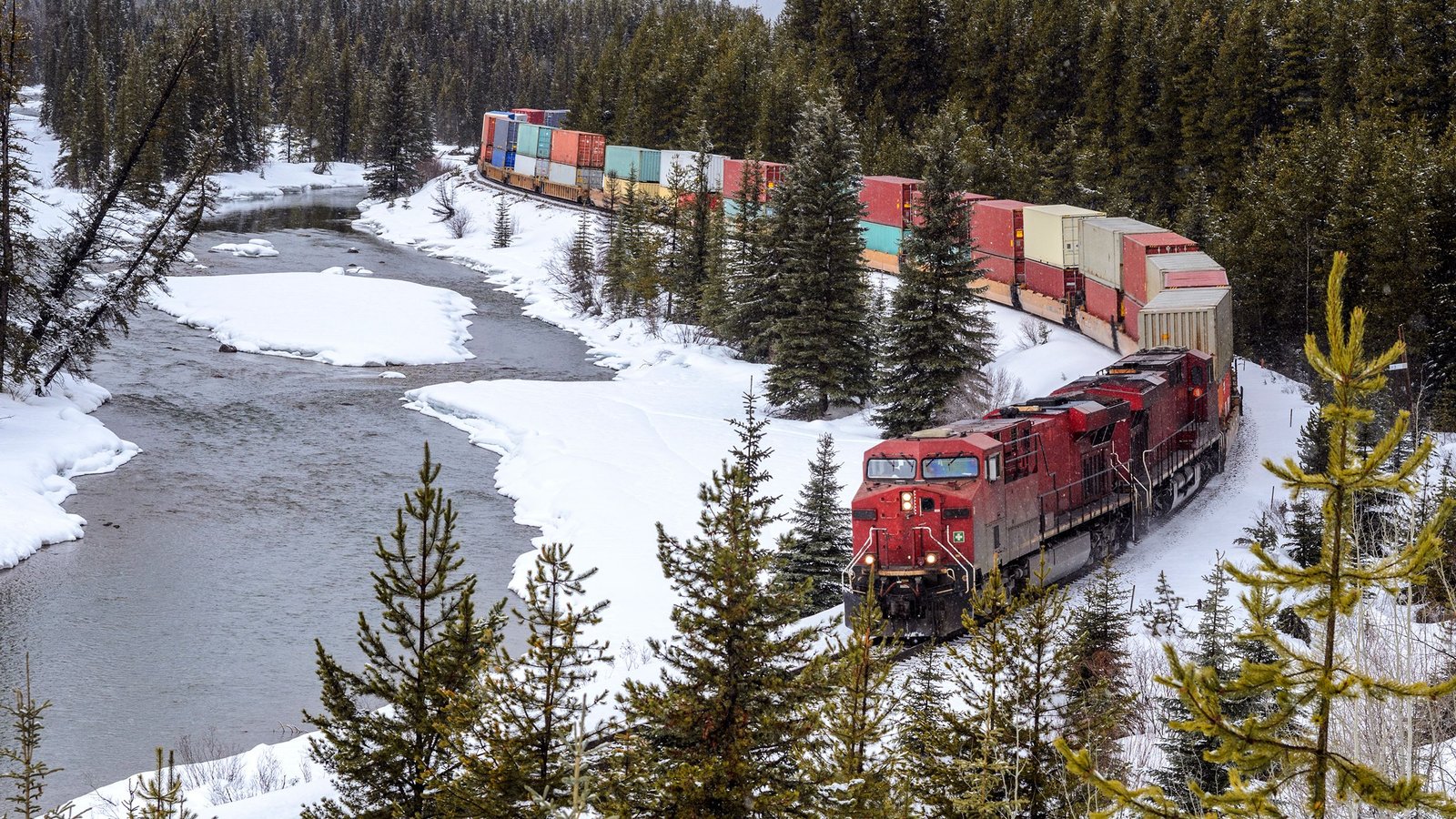
A single locomotive weighing a fraction of its total cargo successfully hauls thousands of tons across continents by strategically exploiting the fundamental laws of static friction and mechanical engineering. While a 170-pound human pulling 12,000 pounds seems physically impossible, the rail industry achieves this daily by managing the resistance between surfaces to maximize traction and minimize drag.
The Science of Grip: Defining Static Friction
Understanding locomotive power begins with static friction—the force that resists the initial motion between two stationary surfaces. According to Newton’s second law, the net force on an object equals its mass multiplied by acceleration ($F=ma$). When a locomotive rests on the tracks, the downward pull of gravity is countered by an upward “normal force” from the rail. This normal force dictates the maximum potential for static friction.
The relationship is defined by the formula $F le mu_s N$, where $mu_s$ represents the coefficient of friction specific to the materials in contact. For steel wheels on steel rails, this coefficient is approximately 0.74. As the locomotive applies force, static friction matches that force in the opposite direction to prevent slipping—until the applied force exceeds the maximum threshold, at which point the wheels begin to slide and traction is lost.
The Paradox of Movement: Static vs. Kinetic Friction
Contrary to intuition, static friction—not kinetic friction—enables a train to move. Just as a human foot uses static friction to push off the ground without sliding, a locomotive’s driving wheels utilize the high grip of stationary contact to propel the entire consist forward. Once a surface begins to slide, it enters the realm of kinetic friction, which is significantly weaker and less efficient.
In a hypothetical tug-of-war between two locomotives, the heavier engine typically wins because its greater mass generates a higher normal force, thus increasing its maximum static friction. However, if the heavier engine’s wheels begin to spin (skidding), it loses the advantage. Because the coefficient of kinetic friction for steel on steel (0.57) is lower than the static coefficient (0.74), a slipping wheel provides less pulling power than a gripping one. This physical reality allows a lighter, high-traction engine to outpull a heavier, skidding opponent.
Engineering the Advantage: Bearings and Slack Action
A locomotive does not need to be heavier than its combined cargo because the cars it pulls are engineered for near-zero resistance. While the engine requires high friction for traction, the freight cars utilize advanced mechanical components to eliminate sliding friction. Modern roller bearings and high-performance lubrication reduce the kinetic friction coefficient within wheel axles from 0.56 to as low as 0.002.
The Strategic Use of Slack Action
Overcoming the initial inertia of a 10,000-ton train requires more than just raw power. Engineers utilize “slack action,” a deliberate looseness in the couplings between cars. When the locomotive starts, it pulls only the first car. As that car begins to move, the slack disappears for the second car, then the third, and so on. This sequential start allows the locomotive to overcome the static friction of one car at a time rather than attempting to move the entire mass simultaneously, effectively “breaking” the inertia of the train in stages.
Efficiency on Rails: The Rolling Friction Advantage
The superiority of rail transport also stems from the minimization of rolling friction. Unlike rubber tires on a truck, which deform under weight and dissipate energy as heat, steel wheels maintain their rigid shape. This lack of deformation ensures that nearly all energy produced by the locomotive translates into forward motion rather than being lost to heat. By combining the high-traction grip of the engine with the low-resistance movement of the cargo, trains remain one of the most energy-efficient methods for transporting massive loads over long distances.