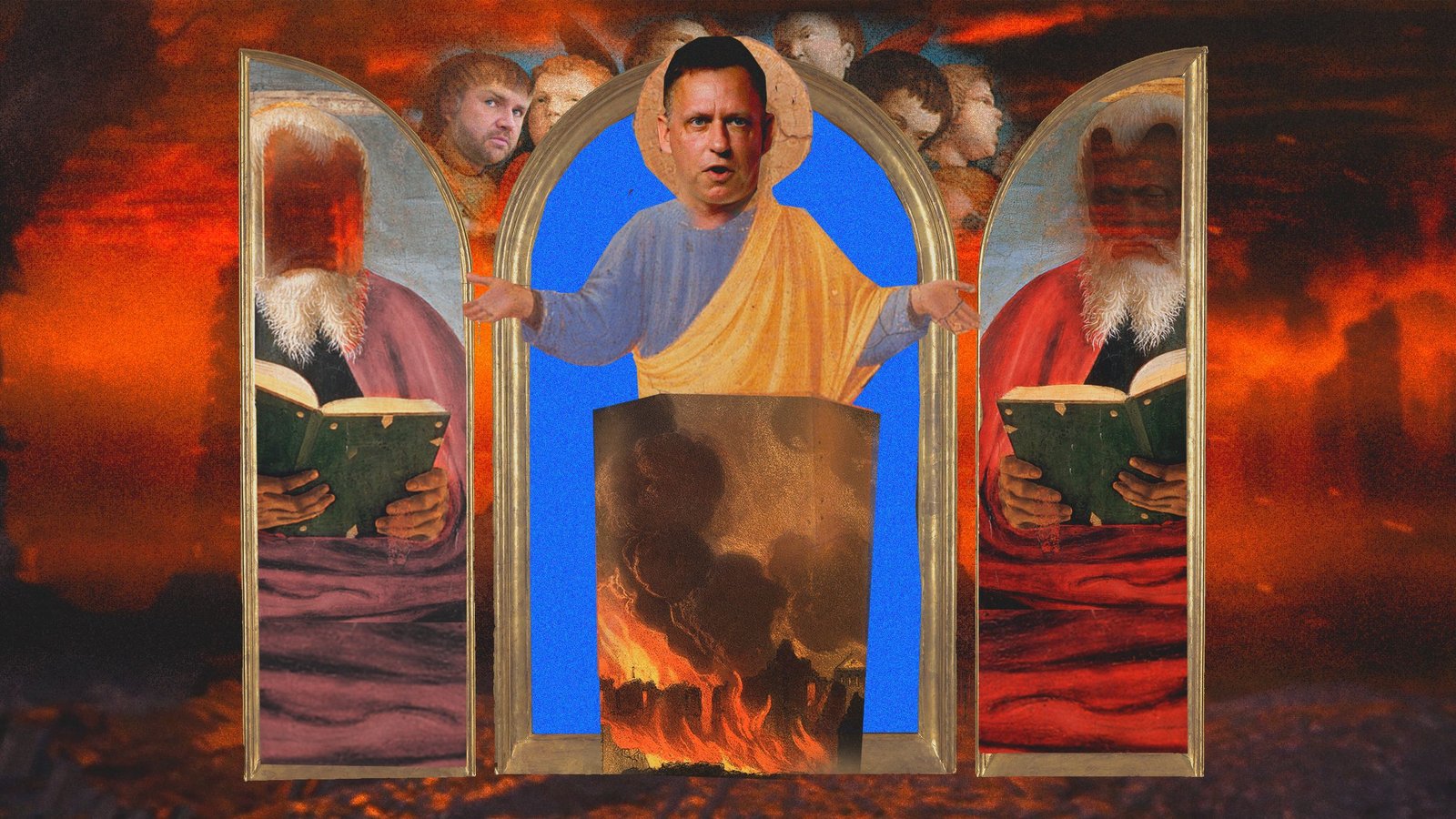
Silicon Valley billionaire Peter Thiel is increasingly framing his global influence through the lens of apocalyptic theology, specifically the “Antichrist,” to justify a radical shift in technology and politics. During a series of private lectures beginning in Paris in 2023, the Palantir co-founder argued that humanity faces a dual threat: technological annihilation or a unified global tyranny he equates with biblical evil. This preoccupation is not merely academic; it serves as the intellectual scaffolding for his interventions in American democracy and the surveillance industry.
The Secret Paris Lecture: Thiel’s Doomsday Roadmap
In mid-2023, at the Catholic University of Paris, Thiel delivered a nearly hour-long discourse on Armageddon to a room of scholars devoted to René Girard, the late French-American theorist. Thiel, a self-described “hardcore Girardian,” used this unpublicized event to reconstruct his vision of the future. He described a modern world paralyzed by “listless” innovation and plummeting fertility, a “zombie age” where civilization is more terrified of its own tools than its stagnation.
According to Thiel, this neurotic desperation to avoid nuclear war or AI catastrophes makes humanity susceptible to a greater threat: the Antichrist. In Thiel’s theological framework, the Antichrist is not a monster from a horror film but a political figure who unifies the world under the guise of “peace and safety.” For Thiel, any attempt at global governance is synonymous with this apocalyptic evil.
Defining the Enemy: The Crusade Against Global Regulation
Thiel’s “Antichrist” manifests in contemporary figures who prioritize safety over progress. He specifically pointed to AI “doomers” like philosopher Nick Bostrom, who has proposed global surveillance systems to prevent technological disasters. To Thiel, these institutions are “focused single-mindedly on saving us from progress,” creating a regime of pent-up energy that he believes will eventually lead to an explosion of civilization-ending violence.
The Katechon: The Restrainer of Chaos
Central to Thiel’s worldview is the “Katechon”—a biblical concept of a force or figure that holds back the Antichrist and the end of the world. To navigate this, Thiel draws heavily from Carl Schmitt, the controversial German jurist who provided the legal justifications for the Nazi regime. While Thiel’s critics find the association with a Nazi-linked theorist horrifying, Thiel views Schmitt’s “friend-enemy” distinction as a necessary “robust conception of the political.”
The Wolfgang Palaver Connection: A Mimetic Rivalry
Thiel’s obsession with Schmitt and the apocalypse is deeply intertwined with the work of Wolfgang Palaver, an Austrian theologian and lifelong peace activist. Since meeting in 1996, Thiel has closely followed Palaver’s scholarship, often paraphrasing it in his own doomsday lectures. However, the two men represent opposite poles of the same theory. While Palaver uses Girardian mimesis to argue for Christian non-violence and the rejection of scapegoating, Thiel appears to use it as a manual for strategic intervention.
Palaver has expressed growing concern that Thiel has arrived at a “catastrophic interpretation” of these theories. In their private correspondences, Palaver has urged Thiel to “go to church”—a Girardian directive to seek spiritual peace rather than political dominance. Thiel has recently adopted this phrase in public interviews, though his actions suggest he remains committed to a more Schmittian path.
From Theory to Power: Palantir, JD Vance, and National Conservatism
Thiel’s theological fascinations are directly reflected in his business and political portfolios. His co-founding of Palantir Technologies—a surveillance giant serving the CIA and global intelligence agencies—aligns with his 2004 proposal for a “secret coordination of the world’s intelligence services” as a way to bypass traditional democratic checks and balances.
Furthermore, Thiel’s mentorship of Vice President-elect JD Vance illustrates the practical application of Girardian theory. Vance has openly credited Thiel and Girard for his conversion to Catholicism, yet his political rhetoric—specifically the targeting of immigrant groups—has been criticized by other Girardian scholars as a classic “scapegoat mechanism.” These scholars argue that Vance and Thiel are utilizing the very cycles of collective violence that Girardian theory warns against.
The Multipolar Katechon
Thiel’s support for the National Conservatism movement also mirrors Schmitt’s postwar vision of a “multipolar” world. This ideology rejects universalist organizations like the United Nations in favor of independent, self-interested nations. By funding these movements, Thiel is effectively investing in “Katechons”—nationalist structures designed to prevent a unified global state, even if those structures themselves rely on illiberal power.
Conclusion: A Billionaire’s Hedge Against the End
As Thiel continues his “doomsday road show,” the question remains whether he is attempting to save humanity or accelerating its arrival at the “final catastrophe.” By simultaneously building surveillance tools that could empower a global dictator and funding nationalist movements that fracture global unity, Thiel is hedging his bets on every side of the apocalyptic equation. As Palaver notes, Thiel’s drive for security may be his greatest vulnerability: “If your main thing is seeking protection, you play with fire.”