
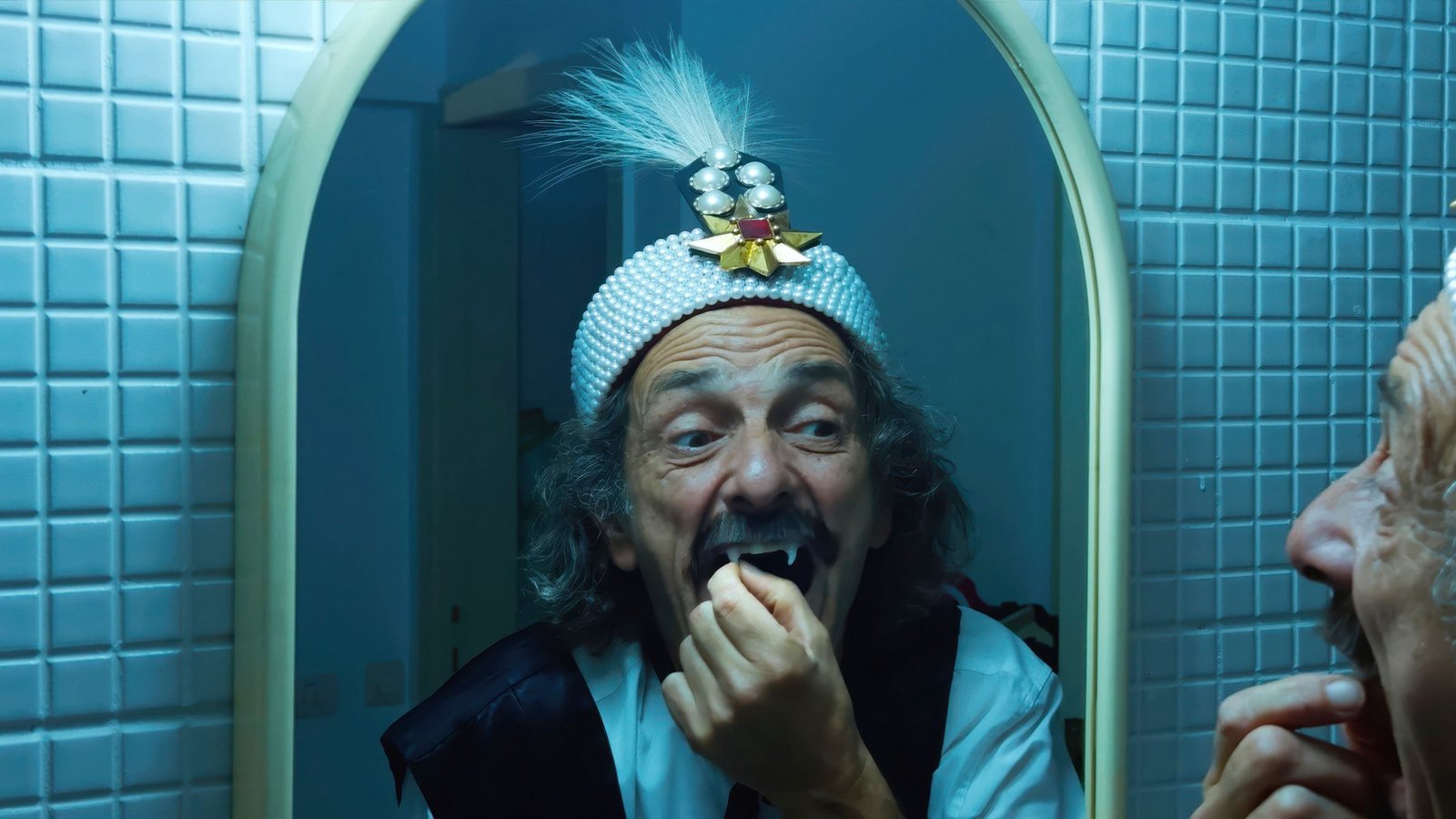
Romanian director Radu Jude, winner of the Berlin International Film Festival’s Golden Bear, is igniting a new firestorm in global cinema with his three-hour epic, Dracula. Premiering October 29, the film utilizes generative AI to create intentionally “slimy” and “gross” imagery, serving as both a critique of the technology and a reflection of the internet-induced derangement defining the modern era. By framing the narrative around a director who turns to artificial intelligence to solve a creative block, Jude forces the audience to confront the unsettling convergence of high art and digital “slop.”
A Meta-Narrative of Creative Exhaustion and AI Prompts
Radu Jude has built a career on dissecting cultural hypocrisy, from the viral porn scandals of Bad Luck Banging or Loony Porn to the toxic masculinity parodied in Do Not Expect Too Much From the End of the World. In Dracula, he shifts his lens toward the “margins of Europe” and the global anxiety of 24/7 internet connectivity. The film follows a fictional filmmaker (Adonis Tanta) tasked with producing a vampire blockbuster. Lacking inspiration, the protagonist feeds prompts into an AI app, which generates the surreal, disjointed vignettes that form the movie’s core.
Vignettes of Blood, Gore, and Full-Frontal Nudity
The resulting segments range from the absurd to the obscene. One sequence features a pornographic stage production of Dracula being dismantled by a mob of tourists; another reimagines the Count as a tyrannical corporate executive presiding over a workshop of tech laborers. Jude populates these scenes with a relentless barrage of AI-generated images—including depictions of Vlad Tepes and hypersexualized, distorted human forms—that challenge even his most loyal art-house admirers.
Embracing the “Slop”: Finding Poetry in Digital Errors
While the creative industry largely views generative AI as an existential threat to human labor, Jude approaches it with a mix of curiosity and cynicism. He describes the AI-generated output as inherently kitsch and lacking traditional beauty. However, Jude argues that there is a “digital poetry” found in the machine’s failures. He deliberately preserved “wrong” results—figures with three hands, four heads, or misplaced genitalia—to highlight the primitive, monstrous quality of the technology.
This aesthetic choice draws inspiration from composer John Cage, who believed that all sounds, even traffic or rain, could be perceived as music. Jude applies this philosophy to the “empire of images,” suggesting that even the ugliest digital artifacts are worthy of intellectual interest. By refusing to sanitize the AI output, Jude highlights the ontological difference between a human-captured photograph and a machine-generated hallucination.
The Vampiric Nature of Generative Technology
The director does not shy away from the ethical controversies surrounding his methods. Jude acknowledges the economic and environmental concerns raised by AI, particularly in the United States where the stakes for the film industry are significantly higher. He views the technology as a perfect metaphor for capitalism, citing Marx’s comparison of capital to a vampire that survives by sucking the “living labor” out of creators.
A Tool for Critique, Not a Replacement
Despite the backlash from purists who see any use of AI as a betrayal of the cinematic spirit, Jude maintains that it is simply a tool. He utilized the technology partly due to budget constraints and partly to see if he could “out-weird” the machine by exploring themes it was programmed to reject, such as extreme sexual content. While his current projects have returned to traditional methods, Jude remains open to using AI-generated voices or imagery if the narrative demands it, emphasizing that art thrives on provocation and conflict.