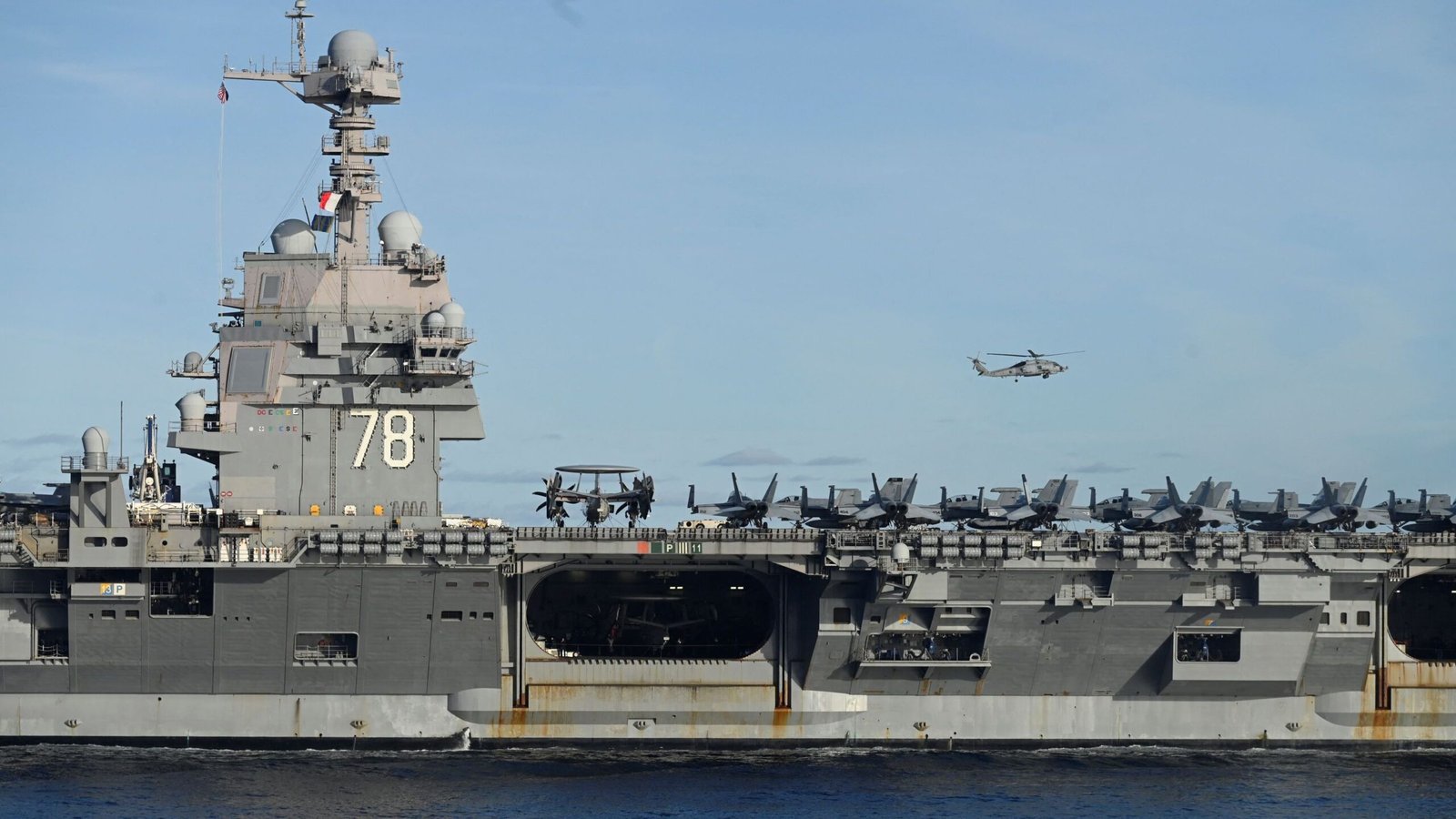
The Pentagon has officially deployed the USS Gerald R. Ford, the world’s most advanced nuclear-powered aircraft carrier, to the Caribbean to spearhead an escalated anti-narcotics campaign targeting illicit actors in the Western Hemisphere. Sean Parnell, Assistant Secretary of Defense for Public Affairs, confirmed the strategic move, stating that the vessel’s presence will bolster the United States’ capacity to detect and dismantle criminal organizations that compromise regional prosperity. This mobilization marks a significant intensification of the Trump administration’s maritime crackdown, which has already fueled diplomatic friction with nations such as Venezuela and Colombia.
A $13 Billion Shift in Regional Maritime Strategy
The arrival of the USS Gerald R. Ford represents more than a routine patrol; it introduces the most expensive and technologically sophisticated vessel in naval history to a theater previously monitored by smaller combat ships. Valued at approximately $13 billion, the Ford serves as the flagship for a new generation of carriers designed to supersede the Nimitz class, which has remained the Navy’s primary power projector since the 1970s. Developed by the Newport News Shipbuilding division of Huntington Ingalls Industries, the vessel is the cornerstone of the CVN-21 Aircraft Carrier Program.
Engineering Superiority: The Nuclear Core of the Ford Class
The USS Gerald R. Ford features a radical departure from legacy naval engineering, displacing nearly 100,000 tons with a massive 333-meter hull. At its heart lies an advanced nuclear propulsion system engineered by Northrop Grumman. This system, consisting of two reactors and four shafts, increases power generation and distribution by 150 percent over its predecessors. This energy surplus allows the ship to operate for 20 years without refueling, powering a zonal electrical distribution system that supports the vessel’s cutting-edge combat suites.
Revolutionizing Naval Aviation with EMALS Technology
The carrier’s most critical innovation is the Electromagnetic Aircraft Launch System (EMALS). By replacing traditional steam-powered catapults with linear electromagnetic accelerator motors, the Ford achieves precise control over aircraft acceleration. This allows the Navy to launch manned jets and unmanned aerial vehicles (UAVs) at higher speeds and with heavier payloads, significantly extending their operational lethality. Complementing this is the Advanced Arresting Gear (AAG), which utilizes electromagnetic motors to safely decelerate everything from lightweight drones to heavy supersonic fighters, reducing physical stress on the airframes.
High-Speed Munitions and Precision Tracking
To maximize sortie rates, the ship utilizes 11 advanced weapons elevators powered by electromagnetic motors rather than hydraulic systems. These elevators transport missiles, torpedoes, and bombs from deep magazines to the flight deck with unprecedented efficiency. For navigation and combat, the Ford integrates S-band volumetric search and X-band multifunctional radars, capable of tracking hundreds of aerial and maritime targets simultaneously across vast distances. Furthermore, its landing system discards traditional radar in favor of GPS technology corrected by a fixed local reference station, ensuring pinpoint landing accuracy even in adverse weather or heavy seas.
Strategic Deterrence vs. Tactical Drug Interdiction
The USS Gerald R. Ford carries a formidable air wing of up to 90 aircraft, including F/A-18 Super Hornets equipped for electronic warfare and E-2 Hawkeye surveillance planes. While the vessel can sustain over 160 air operations per day—surging to 220 during high-intensity conflict—experts question its utility in chasing drug runners. An analysis from the Center for Strategic and International Studies (CSIS) suggests the deployment functions primarily as a political signal of deterrence. While the carrier’s sensors aid in detection, these behemoths are optimized for amphibious assaults and air strikes rather than the granular surveillance required to intercept small smuggling vessels. The move signals a major strategic commitment, prioritizing power projection in the Caribbean corridor.