
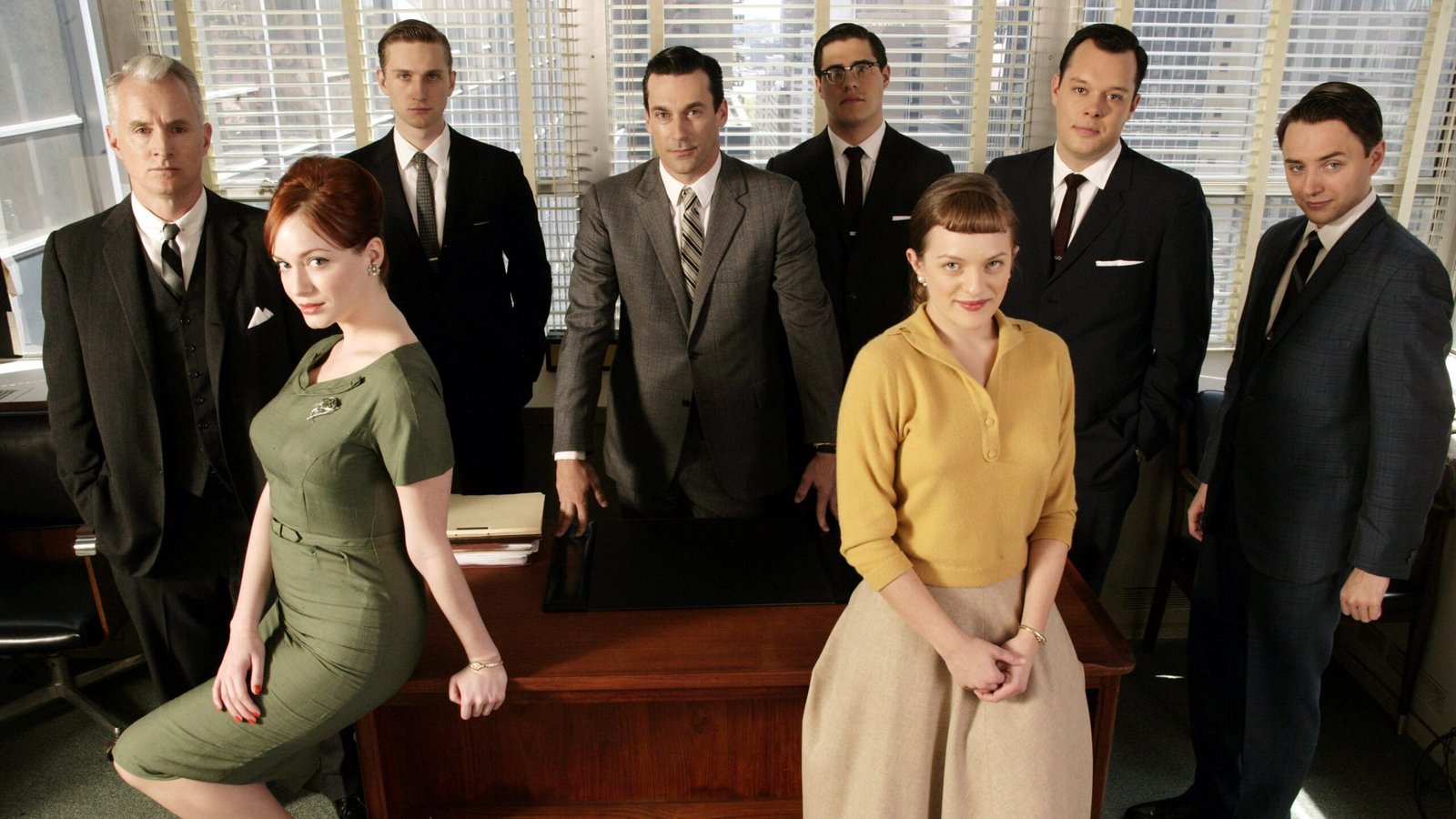
HBO Max inadvertently exposed production secrets this week after a botched high-definition remaster of the Season One Mad Men episode “Red in the Face” revealed off-camera crew members on-screen, highlighting the aesthetic risks of forcing classic television into modern aspect ratios. The error, which quickly went viral on social media, shows two crew members in modern attire lurking in the background of a 1960s setting, visibly feeding a hose to facilitate actor John Slattery’s famous vomiting scene. While the original version on AMC+ maintains the period-appropriate illusion with seven men in suits, the new high-clarity transfer shatters the fourth wall by exposing the mechanics of the special effect.
A Stomach-Churning Technical Oversight
The technical blunder wasn’t limited to visual glitches; it extended to the platform’s user interface. At the time of the discovery, several episodes were mislabeled, forcing viewers to select the episode titled “Babylon” to actually view the “Red in the Face” vomit sequence. For a series defined by its meticulous attention to detail and historical accuracy, the inclusion of crew members in the frame serves as a literal “Not great, Bob!” moment for the streaming giant. This incident underscores a recurring problem in the streaming era: the transition of legacy content to high-definition platforms often sacrifices artistic intent for pixel density.
The Hidden Cost of Widescreen Modernization
History suggests that Mad Men is not an isolated case. Most 20th-century television was produced in a 4:3 aspect ratio and standard definition. When studios attempt to “upgrade” these shows to 16:9 widescreen, they typically choose between cropping the top and bottom of the image or revealing the “dead space” on the sides that was never meant for public viewing. Buffy the Vampire Slayer famously suffered from visible crew members and equipment in its widescreen conversion, while The X-Files episode “Gender Bender” accidentally revealed a male stunt double waiting in the wings due to the expanded frame.
Cropping presents even more significant hurdles for visual storytelling, particularly in comedy. When Seinfeld moved to widescreen, the “pothole” central to a specific George Costanza plotline was cropped out of the frame. Similarly, The Simpsons lost a legendary sight gag at the Duff brewery when it debuted on Disney+, as the widescreen crop hid the fact that three different “varieties” of beer were all coming from the same pipe. While Disney eventually offered the original 4:3 aspect ratio as an option, the initial release prioritized filling modern TV screens over preserving the joke.
Why Quality Control Fails in the Streaming Era
The problem deepens as studios employ aggressive AI upscaling and remastering technology. A recent I Love Lucy clip went viral after background actors, originally blurred by standard-definition lenses, were brought into such sharp focus that they resembled distorted, surreal sketches. This “clarity” often works against the medium. In the late 1990s, Frasier producers expressed concern that the shift to HD would reveal the “shabbiness” of their sets, which were designed to look prestigious only under the forgiving gaze of standard definition.
Unlike feature films, which receive frame-by-frame restoration, the sheer volume of television content makes rigorous quality control nearly impossible. The Simpsons has over 400 standard-def episodes; Seinfeld and I Love Lucy have hundreds. Lionsgate reportedly provided HBO Max with “incorrect files” for Mad Men, suggesting that the version uploaded was an unedited take where digital cleanup had not yet occurred. While a source close to the process confirmed that corrected files would be uploaded, the incident raises a fundamental question: why was a remaster necessary for a show that already looked pristine on Blu-ray?
Lessons from The Wire and Don Draper’s ‘Glittering Lure’
Rarely do creators oversee these transitions. David Simon, creator of The Wire, famously insisted on participating in the show’s HD overhaul, acknowledging that while the widescreen format offered some improvements, it fundamentally altered the “grubby” urban aesthetic intended for the original 4:3 broadcast. Simon noted that despite the best efforts in resizing and touchups, some elements simply do not translate to higher resolutions.
In his iconic pitch for the Carousel, Don Draper argued that while “technology is a glittering lure,” the public is most deeply engaged by a sentimental bond. For many viewers, that bond is tied to the specific style and atmosphere of a show’s original era. Preserving the integrity of a masterpiece—even if it means black bars on the sides of the screen or a slightly softer image—is often more valuable than a high-definition update that accidentally reveals the man behind the curtain.